Authentic Teaching – Practices

Simple Effective Instructional Frame

Abderrazak Behhar

When talking about authentic teaching, I mentioned that one aspect that characterizes authentic teachers is their adoption of a simple and effective instructional frame.

Effective teaching, as Schmoker( 2011) explains in his popular book “Focus: Elevating the Essentials” is simple and consists of the common elements of a solid lesson known to all effective teachers.

Schmoker (2011) reminds us of these common elements :

a clear learning objective with some effort to provide background knowledge or create interest in the topic, teaching and modeling, guided practice, checks for understanding / formative assessment and independent practice/ assessment.” (P, 53)

The way Schmoker (2011) describes effective teaching echoes the lesson design developed by Madeline Hunter in 1984. Hunter(1984) as cited in Marzano (2007) suggested that an effective lesson should have the following stages:

  • Anticipatory set – a kind of warm up to hook students’ attention and activate their prior knowledge
  • Objective and purpose – Explaining what is to be learned and why it is important
  • Input – presenting the knowledge and skills needed to achieve the goal of the lesson
  • Modeling – showing students various examples of the targeted knowledge and skills
  • Checking for understanding – making sure that students are ready to carry out the learning tasks; that is to say, they know what to do and have enough prior knowledge and skills.
  • Guided practice – monitoring students’ practice of the newly learned skills and knowledge.
  • Independent practice – engaging students in independent practice.

It is very sad that this simple nature of effective teaching is now blurred with sophisticated terminology and instructional fads.

The practices of effective lesson planning should permeate the instructional practices; Marzano (2007) believes that the stages of Madeline Hunter’s lesson plan should be “routine components of every lesson” (p. 180)

The authentic teacher knows that effective teaching is not a mystery.

The authentic teacher knows that teaching in an effective way means teaching in a simple way.

The authentic teacher knows that teaching in a simple fashion requires creativity and flexibility.


References

Marzano, R. J. (2007). The art and science of teaching: A comprehensive framework for effective instruction. Association for Supervision and Curriculum Development. 

Schmoker, M. J. (2011). Focus: Elevating the essentials to radically improve student learning. ASCD. 

Why do we still need educational philosophy?

Roughly speaking , educational philosophy can be defined as “ the application of philosophical ideas to educational problems, which in turn, can lead to a refinement of both philosophical ideas and educational development” (Ozmon, 2012, p 2).

Education does not exist in a vacuum; education is part of a socio-cultural context that philosophy strives to explore (Ozmon, 2012). Educational philosophy sheds light on how education shapes and is shaped by this panoramic context (Ozmon, 2012).

One might tend to believe that the need for educational philosophy is oudated since we are talking now about a legimate science of education; however, educational philosophy “ has an important role to play in incorporating and examining the value of scientific ideas”.(Ozmon, 2012, p 3).

I personally believe that it is difficult to deny the contribution of science to educational theory today, but it is equally difficult to deny that our educational practices and beliefs lack a coherent, holistic vision as to the purpose of education. Postman (1985) succinctly expresses this dilemma as follows: 

The answer to this question has nothing whatever to do with computers, with testing, with teacher accountability, with class size, and with the other details of managing schools. The right answer depends on two things, and two things alone: the existence of shared narratives and the capacity of such narratives to provide an inspired reason for schooling (as cited in Gunzenhauser, 2003, p.52).”

Professional philosphers are, therefore, mainly concerned with “ providing illumination, understanding, and perspective for educators to think with than on providing programs and policies for educators to act on.” ( Soltis, 1983, p 17).

An authentic teacher draws on educational philosophy as a source of developing his/her personal education platform “ to achieve a satisfying sense of personal meaning, purpose, and commitment to guide his or her activities as an educator” ( Soltis, 1983, p 15).

An authentic teacher is not a fervent supporter of a given educational philosophy, but a relflective practioner who is yearning to improve his/her teaching and brige the gap between practice and theory (Ozmon, 2012).


References

Gunzenhauser, M. G. (2003). High-Stakes Testing and the Default Philosophy of Education. Theory Into Practice, 42(1), 51-58. doi:10.1207/s15430421tip4201_7

Ozmon, H. (2012). Philosophical foundations of education (9th ed.). Upper Saddle River, NJ: Pearson.

SOLTIS, J. (1983). Perspectives on Philosophy of Education. Journal of Thought, 18(2), 14-21. Retrieved August 27, 2021, from http://www.jstor.org/stable/42589009

Reflections on Authentic Teaching!

Authentic Teaching!

I would like first to clarify what authentic teaching is NOT from my perspective.

  1. Authentic teaching is not synonymous with authentic learning. The latter is well part of the instructional practices of authentic teachers but is not as encompassing as authentic teaching since it only “refers to a wide variety of educational and instructional techniques focused on connecting what students are taught in school to real-world issues, problems, and applications.(“Authentic Learning,”n.d).
  2. Authentic teaching is neither synonymous with the notion of teachers’ authenticity denoting personal traits of teachers. Authentic teaching is far beyond the teacher as a person. Surely, authentic teachers share some critical personal traits but this is only one facet to authentic teaching.
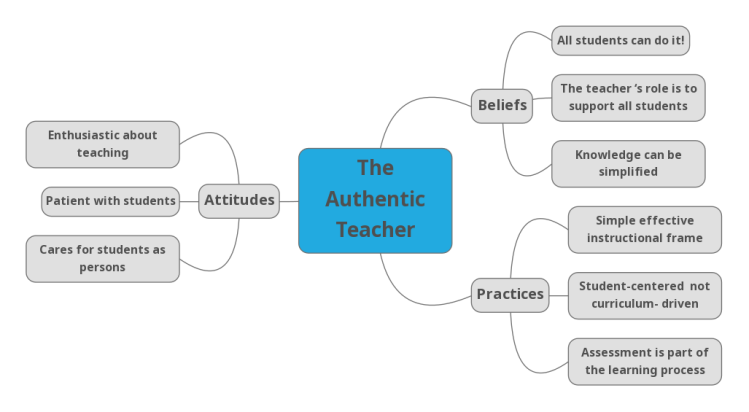
  3. Authentic teaching to me refers to a set of beliefs, attitudes and actions that characterizes authentic teachers in their quest of helping students to come to know. Sergiovanni and Starratt (2002) defines an educational platform as “ a floor of beliefs, opinions, values, and attitudes that provides a foundation for practice” (p.70). The main aspects of the authentic teacher’s educational platform can be represented as follows :

I will detail my definition of the authentic teacher in the coming posts.

Abderrazak Behhar – August 21, 2021.

References:

Authentic learning definition. The Glossary of Education Reform. (2013, September 16). https://www.edglossary.org/authentic-learning/. 

De Bruyckere, P., & Kirschner, P. A. (2016). Authentic teachers: Student criteria perceiving authenticity of teachers. Cogent Education3(1), 1247609. https://doi.org/10.1080/2331186x.2016.1247609 

Sergiovanni, T. J., & Starratt, R. J. (2002). Supervision: A redefinition (7th ed.). McGraw-Hill. 

Major essential questions about teaching!

I would like to devote my first blog post to sharing my essential questions about teaching. I do not mean my questions to be philosophical, though there is no harm in being philosophical about teaching. I do believe that we need educational philosophy more than ever so that we can uncover the true nature of teaching. 

Questions that this blog will be sharing with those interested are the following:

  1. What makes the teaching profession so sophisticated? 
  2. Why do teachers tend to resist change?
  3. What is the rationale behind submerging the teaching profession with jargon?
  4. What do effective teachers have in common?
  5. Is teaching a science, craft, or an art?
  6. Why aren’t all teachers creative?
  7. Why do teachers resist professional development programs?
  8. What are the core skills of effective teachers?
  9. Why has the teaching profession become very hard? 
  10. Why are teachers burned out?

After teaching for more than 25 years, I am still asking these questions with the same anxiety and desire to find satisfying answers. This blog will share with you some of my reflections based on my very humble experience. I will definitely ask more questions. Asking questions is at the heart of reflection, as John Dewey said,“We do not learn from experience… we learn from reflecting on experience.”

Abderrazak Behhar – August 15, 2021.