Authentic Teachers: Centering Learning on Students, Not Compliance

In a world where educational mandates and standards often dominate classroom priorities, authentic teachers stand out. They don’t teach to the curriculum; they teach to the learner. For them, curriculum compliance and coverage are important but secondary. Their true focus lies in meeting learners where they are and guiding them toward meaningful growth.

Authentic teachers consistently demonstrate a powerful, student-centered approach to teaching and learning. Here’s what sets them apart:

1. They Start with the Learner’s Mind

Authentic teachers invest considerable time activating and building upon students’ prior knowledge.
This is not a perfunctory warm-up exercise; rather, it’s a thoughtful process aimed at assessing students’ readiness to engage with new concepts, skills, and information. By anchoring new learning to what students already know and care about, they ensure that conceptual connections are strong and lasting.

2. They Scaffold Learning with Care and Clarity

Rather than leaving learning to chance, authentic teachers are master scaffolders. They set clear learning intentions and success criteria, often supported by real examples of performance tasks. This transparency empowers students to understand expectations, see what success looks like, and feel a sense of ownership over their learning journey.

3. They Empower Student Voice and Choice

Authentic teachers recognize that learning is most powerful when students have agency. They offer meaningful choices in how students demonstrate their understanding, whether through writing, presentations, projects, or other creative forms.
Moreover, they create spaces for students to discuss the relevance of what they are learning and reflect on their progress. Students are not just passive recipients of information—they are active partners in the learning process.


Authentic Teachers – Enthusiasm

According to Webster’s Dictionary, etymologically, “enthusiasm” means “inspiration or possession by a god.” Authentic Teachers are actually possessed! They are passionate about the act of teaching. This attitude impacts student learning, as enthusiastic teachers are more likely to engage their learners and instill in them a love of what they are learning.

The questions that come to mind are the following:

Is enthusiasm a prerequisite attitude that some teachers have? Or is it a skill to learn?

How does teacher enthusiasm show in practice?

Actually, some teachers are endowed with the bliss of being enthusiastic about teaching for various reasons, ranging from personal traits to a love of an academic subject or/and a love of the teaching profession.

However, teachers can learn how to be enthusiastic if they are well-coached.

Here are key features that typical enthusiastic teachers exhibit:

a. Showing personal passion in what they are teaching, fostering learners’ interest in what they are learning

b. Facilitating new concepts and ideas by exploring connections with the real world. Learners will be engaged if they see genuine value in their learning.

c. Encouraging learners to cultivate personal views on what they are learning. Learners are more likely to be on task if they feel that their opinions matter.

d. Celebrating learners’ successes. This creates an atmosphere of joy and motivation.

e. Leveraging learners’ misconceptions and errors to explore what they learn. This creates a positive mindset and an environment conducive to risk-taking and exploring alternative ways of coming to know.

d. Authentic Teachers use humor to create a relaxed environment and to explain complex concepts. Humor is magical in grabbing learners’ attention and establishing an affective rapport with them.

Educators that have impacted me

  1. Dr. Lawrence Creedon: Dr. Lawrence Creedon is an educational consultant and expert on teaching and learning. He has written extensively on instructional strategies and school leadership. https://larrycreedon.wordpress.com/
  2. Mike Schmoker: Mike Schmoker is an educational consultant and author. He has written numerous books on education and is well-known for his work on instructional strategies and school reform. http://www.mikeschmoker.com/
  3. Robert Marzano: Dr. Robert Marzano is a renowned educational researcher and consultant. He has written numerous books and articles on education, and is well-known for his work on effective teaching strategies and school leadership. https://www.marzanoresources.com/blog/
  4. Jay McTighe: Jay McTighe is an educational consultant and expert on teaching and learning. He has written extensively on instructional strategies and the use of technology in the classroom. https://jaymctighe.com/
  5. Grant Wiggins: Grant Wiggins was an educational consultant and author. He was well-known for his work on assessment and evaluation, and co-authored the book “Understanding by Design” with Jay McTighe. https://authenticeducation.org/blog/
  6. Jacqueline Grennon Brooks: Jacqueline Grennon Brooks is an educational consultant and expert on teaching and learning. She has written extensively on instructional strategies and the use of technology in the classroom. https://www.tcpress.com/jacqueline-grennon-brooks
  7. Thomas R. Guskey: Thomas R. Guskey is an educational consultant and expert on assessment and evaluation. He has written numerous books on these topics and is well-known for his work on formative assessment. https://tguskey.com/
  8. Richard DuFour: Richard DuFour was an educational consultant and author. He was well-known for his work on school leadership and professional learning communities, and co-authored several books on these topics. https://www.allthingsplc.info/mobile/blog/author/view/2
  9. Heidi Hayes Jacobs: Heidi Hayes Jacobs is an educational consultant and expert on curriculum design and technology in education. She has written numerous books on these topics and is well-known for her work on educational mapping. https://www.chalk.com/resources/webinar-post-pandemic-curriculum-mapping/
  10. Gini Rojas: Gini Rojas is an educational consultant and expert on teaching and learning. She has written extensively on instructional strategies and the use of technology in the classroom. https://sites.google.com/kis.or.kr/kispridepd/2018-19/gini-rojas
  11. Kagan Spencer: Kagan Spencer is an educational consultant and expert on cooperative learning and classroom management. He has written numerous books on these topics and is well-known for his work on Kagan Structures, a cooperative learning approach. https://spencerkagan.weebly.com/

Who are Authentic Leaders?

Authentic leaders inspire, motivate their colleagues and foster a climate of mutual support and shared decision-making: 

Walumbwa et al. (2008: 94) define authentic leadership as ‘a pattern of leader behavior that draws upon and promotes both positive psychological capacities and a positive ethical climate, to foster greater self-awareness, an internalized moral perspective, balanced processing of information, and relational transparency on the part of leaders working with followers, fostering positive self-development.’ 1

Authentic leaders’ professionalism springs from their commitment to their mission and educational platform. Authentic leaders are explicit about their educational platforms and genuinely interested in sharing their educational beliefs and vision.

Shamir and Eilam (2005) assert authentic leaders have the following characteristics: (1) they do not fake their leadership, rather stay true to themselves as opposed to conforming to the expectations of others; (2) they do not take on a leadership role for status, honor, or personal rewards, but rather to promote a value-based cause or mission; (3) while their values, convictions, causes, and missions may be similar to others, they hold them because they have internalized them from personal experiences not because they are imitating others; and (4) their actions are based on their values and convictions.2

Authentic leaders are transformational leaders par excellence: 

Transformational and authentic leadership share some conceptual overlap, with authentic leadership often being described as a subset of transformational leadership (Walumbwa et al., 2008). Specifically, transformational leadership suggests that these leaders serve as role models and display moral conduct. Authentic leaders are also believed to be role models by showing their true self to their followers and demonstrating moral behaviors in line with their values.3

References:

  1. Walumbwa, F. O., Avolio, B. J., Gardner, W. L., Wernsing, T. S., & Peterson, S. J. (2008). Authentic leadership: Development and validation of a theory-based measure. Journal of Management, 34(1), 89-126. https://doi.org/10.1177/0149206307308913

2. Shamir, B., & Eilam, G. (2005). What’s Your Story?: A Life-Stories Approach to Authentic Leadership Development. The Leadership Quarterly, 16(3), 395-417. DOI:10.1016/j.leaqua.2005.03.005

3. Malloy, E., & Kavussanu, M. (2021). A comparison of authentic and transformational leadership in sport. Journal of Applied Social Psychology, 51(7), 636–646. https://doi.org/10.1111/jasp.12769

Authentic Teachers and Learning Theories

Free illustrations of Brain

For over a century, researchers have been exploring the various aspects of human learning and have developed a range of principles and theories. Four major trends can be identified in the field of learning theory: behaviorism, cognitivism, social cognitivism, and neurocognitivism.

Behaviorism is a perspective based on the premise that learning is observable and measurable behavior. Behaviorists believe that learning occurs by means of reinforcing certain behaviors, either positive reinforcement (such as rewards) or negative reinforcement (such as punishments).

Cognitivists, on the other hand, views learning as an internal mental process. They emphasize the central role of mental processes, such as perception, memory, and problem-solving.

Social cognitivism combines elements of behaviorism and cognitivism in that it asserts learning occurs through external reinforcement and internal mental processes while emphasizing the impact of social interactions and the cultural context in which learning occurs.

Neurocognitivism using methods from neuroscience focuses on how the brain impacts human learning and behavior. 

Though cognitive neuroscience has received significant validity in recent years, it is important to recognize that all learning theories have value. They each bring unique insights and raise new questions, help interpret data, and inform instructional strategies. Therefore, authentic teachers should take an eclectic approach to learning theories, incorporating elements from various perspectives to create a balanced and effective approach to teaching. Authentic teachers are naturally influenced by constructivism (both individual and social), self-efficacy, instructional scaffolding, transfer, and motivation.

References

Dweck, C. S. (2006). Mindset: The new psychology of success. New York, NY: Ballantine Books.

Kozulin, A. (2003). Vygotsky’s psychology: A biography of ideas. Cambridge, MA: Harvard University Press.

Pérez-González, J. D. (2014). Constructivism and education. Routledge.

Ormrod, J. E. (2016). Human learning (7th ed.). Boston, MA: Pearson.

Schunk, D. H. (2012). Learning theories: An educational perspective (6th ed.). Boston, MA: Pearson.

Authentic teaching as seen from the perspective of Students

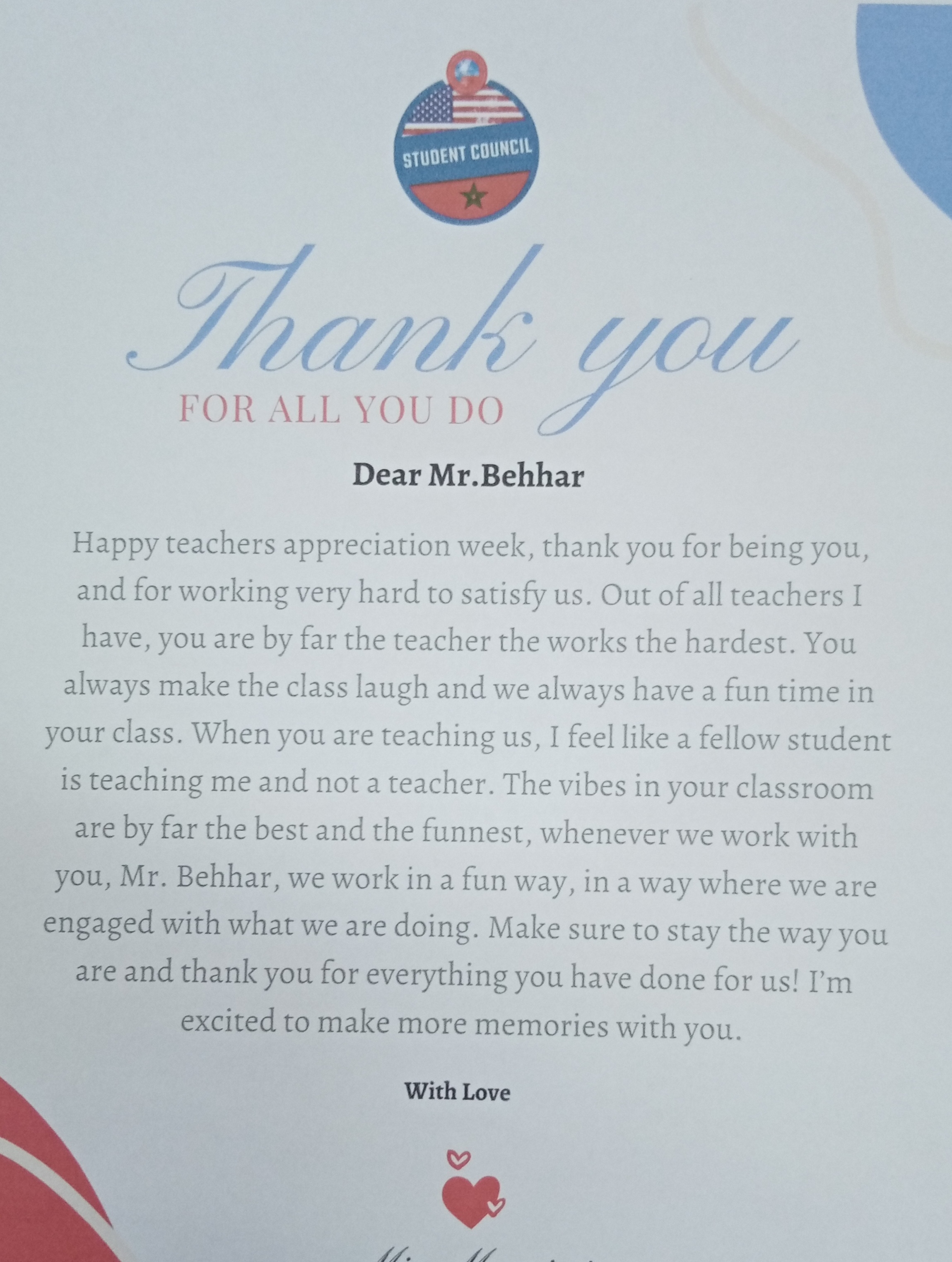
I have just received the letter I am sharing with you on the Teacher’s Appreciation Week. Students were asked to write about a teacher that they would like to recognize for this week. I was moved by this letter drafted by two of my students – a 7th grader and 12th grader. I am so ecstatic to find out that they describe me as an authentic teacher! A Feeling of self-alignment mixed with a sense of fulifiment has overwhelmed me! I thought this moment is worth sharing with my blog readers!

Authentic Teaching – Practices 2

Task Value

Rationale: Authentic Teachers should invite students to find value in the learning task by helping them understand its importance, utility, interest, and cost – whether the task is valuable or not (Ormrod, 2016). In practice, Authentic Teachers are expected, on the one hand, to scaffold students’ learning as needed to increase their sense of competence and self-efficacy. On the other hand, they should encourage students to value what is to be learned by sharing with them their own views, encouraging critical discussions, explaining how what they are learning is impacting their future lives, and instilling in them a love for knowledge (Ormrod, 2016).

Procedure:

— Prior to learning a major task, Authentic Teachers ask students to answer the following questions: 

  1. Importance: Is the task important? How does it connect with your prior knowledge and skills?
  1. Utility: Is the task useful? How is it relevant to real life context? How does it reflect the intended dispositions?
  1. Interest: Is the task interesting? How would the task foster your personal growth?
  1. Cost: What impact can the task have on your learning now, in the near and far future ? How is the task contributing to your academic success? 

— Encourage students to share their answers in pairs, small groups, or with the whole class. 

Assessment: encourage students to include their reflections in their journals or portfolios so that they can refer to them later for self-assessment and/or self-motivation.

A follow up alternative : the same questions could be used as a post reflection ( formative assessment):

  1. Has the task been important? How has it consolidated your prior knowledge and skills?
  1. Has the task been useful? How is it relevant to real life context? Has it fostered the intended dispositions ?
  1. Has the task  been interesting? How has the task fostered your personal growth?
  1. How has learning the task contributed to your academic growth?

Reference:

Ormrod, J. E. (2016). Human learning (7th ed.). Harlow, Essex, England: Pearson.

Authentic Teaching – Practices

Simple Effective Instructional Frame

Abderrazak Behhar

When talking about authentic teaching, I mentioned that one aspect that characterizes authentic teachers is their adoption of a simple and effective instructional frame.

Effective teaching, as Schmoker( 2011) explains in his popular book “Focus: Elevating the Essentials” is simple and consists of the common elements of a solid lesson known to all effective teachers.

Schmoker (2011) reminds us of these common elements :

a clear learning objective with some effort to provide background knowledge or create interest in the topic, teaching and modeling, guided practice, checks for understanding / formative assessment and independent practice/ assessment.” (P, 53)

The way Schmoker (2011) describes effective teaching echoes the lesson design developed by Madeline Hunter in 1984. Hunter(1984) as cited in Marzano (2007) suggested that an effective lesson should have the following stages:

  • Anticipatory set – a kind of warm up to hook students’ attention and activate their prior knowledge
  • Objective and purpose – Explaining what is to be learned and why it is important
  • Input – presenting the knowledge and skills needed to achieve the goal of the lesson
  • Modeling – showing students various examples of the targeted knowledge and skills
  • Checking for understanding – making sure that students are ready to carry out the learning tasks; that is to say, they know what to do and have enough prior knowledge and skills.
  • Guided practice – monitoring students’ practice of the newly learned skills and knowledge.
  • Independent practice – engaging students in independent practice.

It is very sad that this simple nature of effective teaching is now blurred with sophisticated terminology and instructional fads.

The practices of effective lesson planning should permeate the instructional practices; Marzano (2007) believes that the stages of Madeline Hunter’s lesson plan should be “routine components of every lesson” (p. 180)

The authentic teacher knows that effective teaching is not a mystery.

The authentic teacher knows that teaching in an effective way means teaching in a simple way.

The authentic teacher knows that teaching in a simple fashion requires creativity and flexibility.


References

Marzano, R. J. (2007). The art and science of teaching: A comprehensive framework for effective instruction. Association for Supervision and Curriculum Development. 

Schmoker, M. J. (2011). Focus: Elevating the essentials to radically improve student learning. ASCD. 

Reflections on Authentic Teaching!

Authentic Teaching!

I would like first to clarify what authentic teaching is NOT from my perspective.

  1. Authentic teaching is not synonymous with authentic learning. The latter is well part of the instructional practices of authentic teachers but is not as encompassing as authentic teaching since it only “refers to a wide variety of educational and instructional techniques focused on connecting what students are taught in school to real-world issues, problems, and applications.(“Authentic Learning,”n.d).
  2. Authentic teaching is neither synonymous with the notion of teachers’ authenticity denoting personal traits of teachers. Authentic teaching is far beyond the teacher as a person. Surely, authentic teachers share some critical personal traits but this is only one facet to authentic teaching.
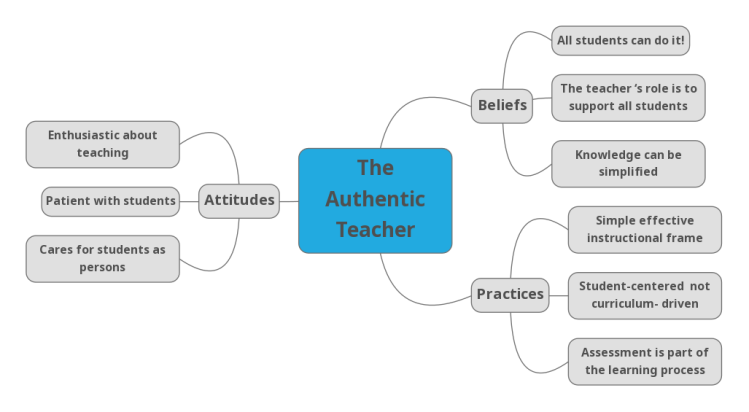
  3. Authentic teaching to me refers to a set of beliefs, attitudes and actions that characterizes authentic teachers in their quest of helping students to come to know. Sergiovanni and Starratt (2002) defines an educational platform as “ a floor of beliefs, opinions, values, and attitudes that provides a foundation for practice” (p.70). The main aspects of the authentic teacher’s educational platform can be represented as follows :

I will detail my definition of the authentic teacher in the coming posts.

Abderrazak Behhar – August 21, 2021.

References:

Authentic learning definition. The Glossary of Education Reform. (2013, September 16). https://www.edglossary.org/authentic-learning/. 

De Bruyckere, P., & Kirschner, P. A. (2016). Authentic teachers: Student criteria perceiving authenticity of teachers. Cogent Education3(1), 1247609. https://doi.org/10.1080/2331186x.2016.1247609 

Sergiovanni, T. J., & Starratt, R. J. (2002). Supervision: A redefinition (7th ed.). McGraw-Hill. 

Major essential questions about teaching!

I would like to devote my first blog post to sharing my essential questions about teaching. I do not mean my questions to be philosophical, though there is no harm in being philosophical about teaching. I do believe that we need educational philosophy more than ever so that we can uncover the true nature of teaching. 

Questions that this blog will be sharing with those interested are the following:

  1. What makes the teaching profession so sophisticated? 
  2. Why do teachers tend to resist change?
  3. What is the rationale behind submerging the teaching profession with jargon?
  4. What do effective teachers have in common?
  5. Is teaching a science, craft, or an art?
  6. Why aren’t all teachers creative?
  7. Why do teachers resist professional development programs?
  8. What are the core skills of effective teachers?
  9. Why has the teaching profession become very hard? 
  10. Why are teachers burned out?

After teaching for more than 25 years, I am still asking these questions with the same anxiety and desire to find satisfying answers. This blog will share with you some of my reflections based on my very humble experience. I will definitely ask more questions. Asking questions is at the heart of reflection, as John Dewey said,“We do not learn from experience… we learn from reflecting on experience.”

Abderrazak Behhar – August 15, 2021.