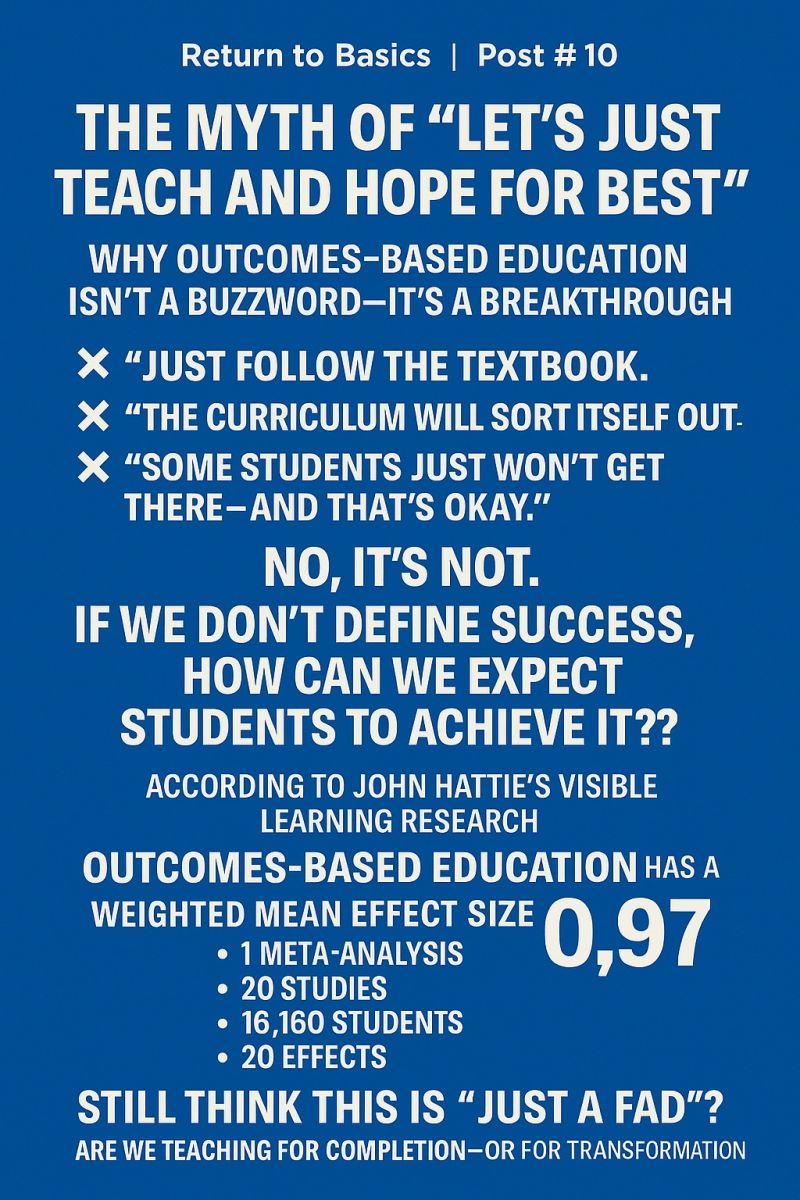
Return to Basics | Post #10: The Myth of “Let’s Just Teach and Hope for the Best”


Why Outcomes-Based Education Isn’t a Buzzword—It’s a Breakthrough

We’ve all heard it:

❌ “Just follow the textbook.”
❌ “The curriculum will sort itself out.”
❌ “Some students just won’t get there—and that’s okay.”

No, it’s not.

Here’s the truth:
If we don’t define success, how can we expect students to achieve it?

That’s the core of Outcomes-Based Education (OBE)—and it’s not what many assume.
It’s not “teaching to the test.”
It’s not “one-size-fits-all.”
It’s not “rigid objectives with no flexibility.”

🔍 OBE means:
• Identifying what truly matters
• Designing learning experiences to reach it
• Expecting all students to achieve it—with the right support

According to John Hattie’s Visible Learning research, Outcomes-Based Education has a weighted mean effect size of 0.97—making it one of the most impactful curriculum approaches ever studied.

📊 Based on:
• 1 meta-analysis
• 20 studies
• 16,160 students
• 20 measured effects

💡 Still think this is “just a fad”?

Outcomes-based thinking forces us to stop glorifying coverage and start prioritizing mastery, equity, and accountability.

Because when the destination is clear, we can build far better pathways.

So here’s the real question:
Are we teaching for completion—or for transformation?

hashtag#ReturnToBasics hashtag#OutcomesBasedEducation hashtag#OBE hashtag#CurriculumMatters hashtag#JohnHattie hashtag#VisibleLearning hashtag#EquityInEducation hashtag#AbderrazakBehhar hashtag#LearningWithPurpose
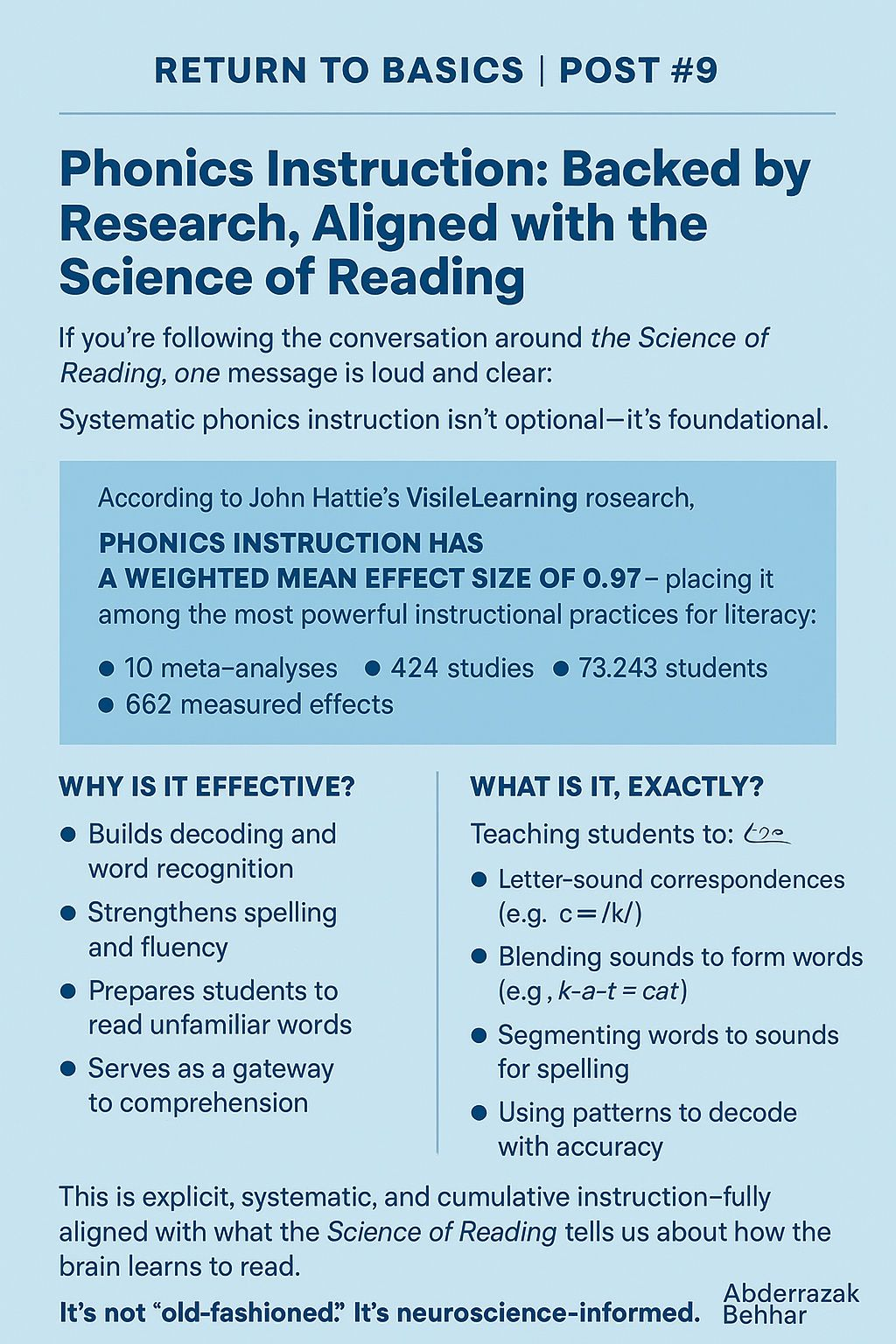
Return to Basics | Post #9: Phonics Instruction: Backed by Research, Aligned with the Science of Reading


If you’re following the conversation around the Science of Reading, one message is loud and clear:
Systematic phonics instruction isn’t optional—it’s foundational.

According to John Hattie’s Visible Learning research, phonics instruction has a weighted mean effect size of 0.97—placing it among the most powerful instructional practices for literacy.
This is backed by
• 10 meta-analyses
• 424 studies
• 73,243 students
• 662 measured effects

✅ Why is it effective?
Phonics instruction:
• Builds decoding and word recognition
• Strengthens spelling and fluency
• Prepares students to read unfamiliar words
• Serves as a gateway to comprehension

✅ What is it, exactly?
Phonics instruction teaches students:
• Letter-sound correspondences (e.g., c = /k/)
• Blending sounds to form words (e.g., k-a-t = cat)
• Segmenting words into sounds for spelling
• Using patterns to decode with accuracy

This is explicit, systematic, and cumulative instruction—fully aligned with what the Science of Reading tells us about how the brain learns to read.

It’s not “old-fashioned.” It’s neuroscience-informed.

As we move forward in literacy reform, let’s stay grounded in what works.

How is your school approaching phonics in light of the new science of reading?

hashtag#ReturnToBasics hashtag#PhonicsInstruction hashtag#ScienceOfReading hashtag#LiteracyMatters hashtag#EarlyLiteracy hashtag#JohnHattie hashtag#VisibleLearning hashtag#ReadingInstruction hashtag#AbderrazakBehhar

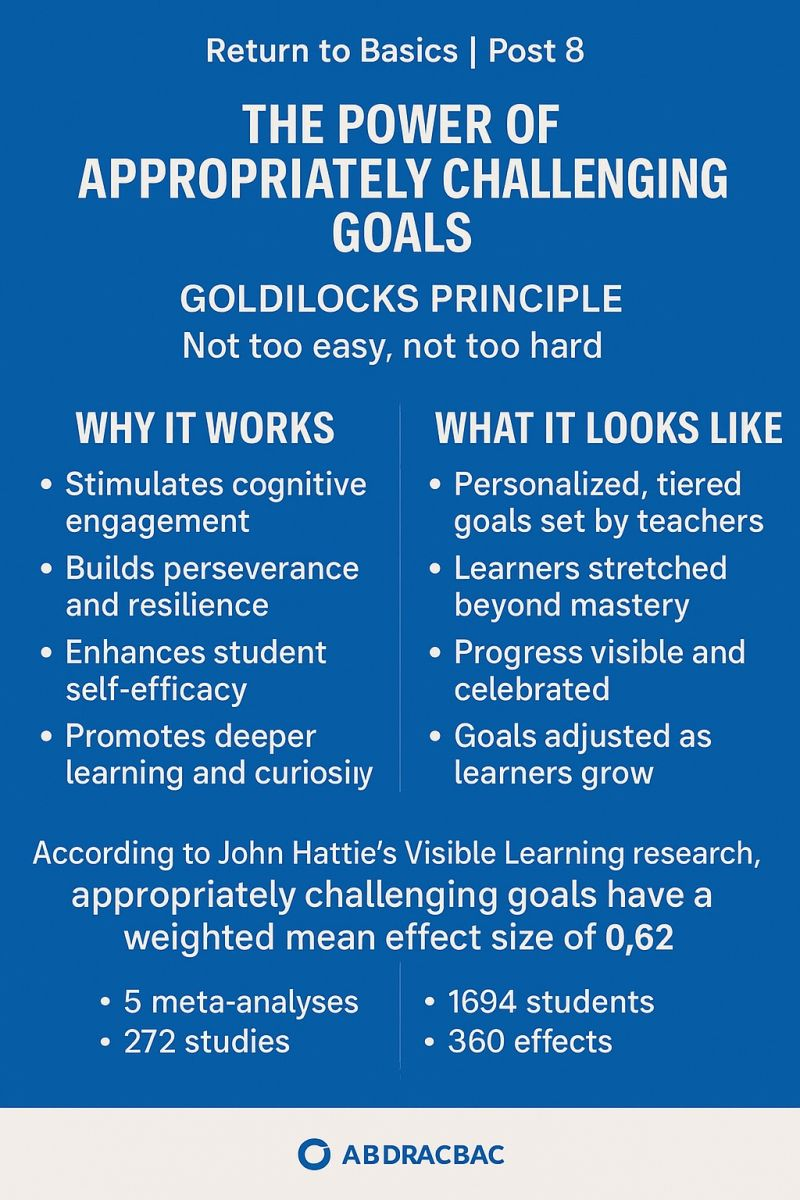
Return to Basics | Post #8: The Goldilocks Principle in Learning: Why Challenge Matters


What drives student growth?
Not just content. Not just effort.
Challenge—just the right kind.

When goals are too easy, students get bored.
When goals are too hard, they disengage.
But when goals are appropriately challenging—not too easy, not too hard—students enter the zone of optimal learning.

This is what John Hattie refers to as the Goldilocks principle of goal-setting.

According to Hattie’s Visible Learning research, appropriately challenging goals yield a weighted mean effect size of 0.62, based on:
• 5 meta-analyses
• 272 studies
• 16,694 students
• 360 measured effects

✅ Why it works:
• Stimulates cognitive engagement
• Builds perseverance and resilience
• Enhances student self-efficacy
• Promotes deeper learning and curiosity

✅ What it looks like in practice:
• Teachers set personalized, tiered goals for students
• Learners are stretched slightly beyond current mastery
• Progress is visible and celebrated
• Goals are adjusted as learners grow

This is not about lowering standards or pushing too hard.
It’s about hitting that just-right challenge level—where students feel the stretch but also see the path forward.

How do you calibrate challenge for your learners?

hashtag#ReturnToBasics hashtag#GoalSetting hashtag#ChallengingGoals hashtag#VisibleLearning hashtag#JohnHattie hashtag#StudentGrowth hashtag#InstructionalLeadership hashtag#AbderrazakBehhar

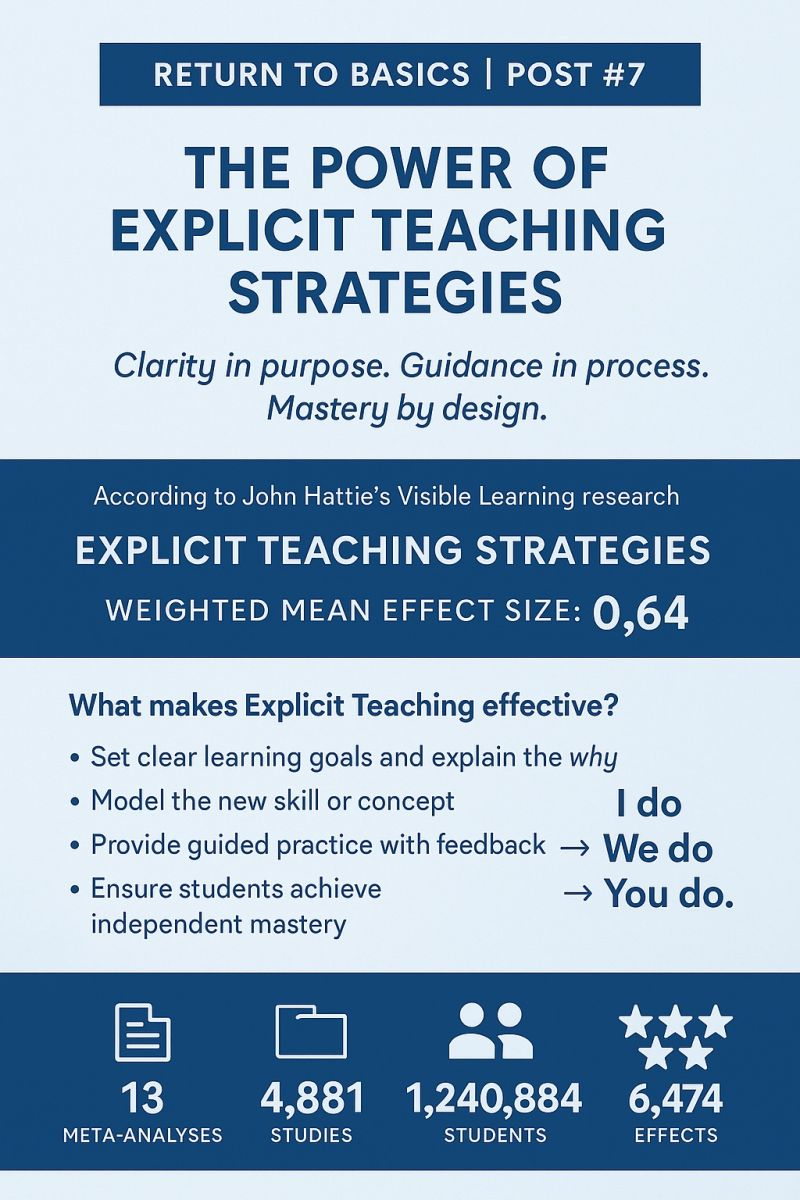
Return to Basics | Post #7: The Power of Explicit Teaching Strategies


Not all scaffolding is made of wood.
Some of the most powerful scaffolds are built in the classroom—step by step, with clarity, purpose, and practice.

That’s what Explicit Teaching offers:
Clarity in purpose. Guidance in process. Mastery by design.

According to John Hattie’s Visible Learning research, Explicit Teaching Strategies have a weighted mean effect size of 0.64, supported by:
• 13 meta-analyses
• 4,881 studies
• 1,240,884 students
• 6,474 effects

What makes Explicit Teaching effective?
It’s not just about “telling”—it’s about leading learning with intentionality:
• Set clear learning goals and explain the why
• Model the new skill or concept
• Provide guided practice with feedback
• Ensure students achieve independent mastery

Think of it as:

“I do → We do → You do.”

Why it works:
• Reduces cognitive overload
• Supports struggling learners
• Reinforces success through repetition and feedback
• Builds confident, capable students

In a world full of noise, clarity is a gift.
Explicit teaching is not rigid—it’s responsive, reflective, and rooted in what works.

How do you make your instruction explicit without making it mechanical?

hashtag#ReturnToBasics hashtag#ExplicitTeaching hashtag#InstructionalScaffolding hashtag#VisibleLearning hashtag#JohnHattie hashtag#HighImpactTeaching hashtag#InstructionalLeadership hashtag#AbderrazakBehhar

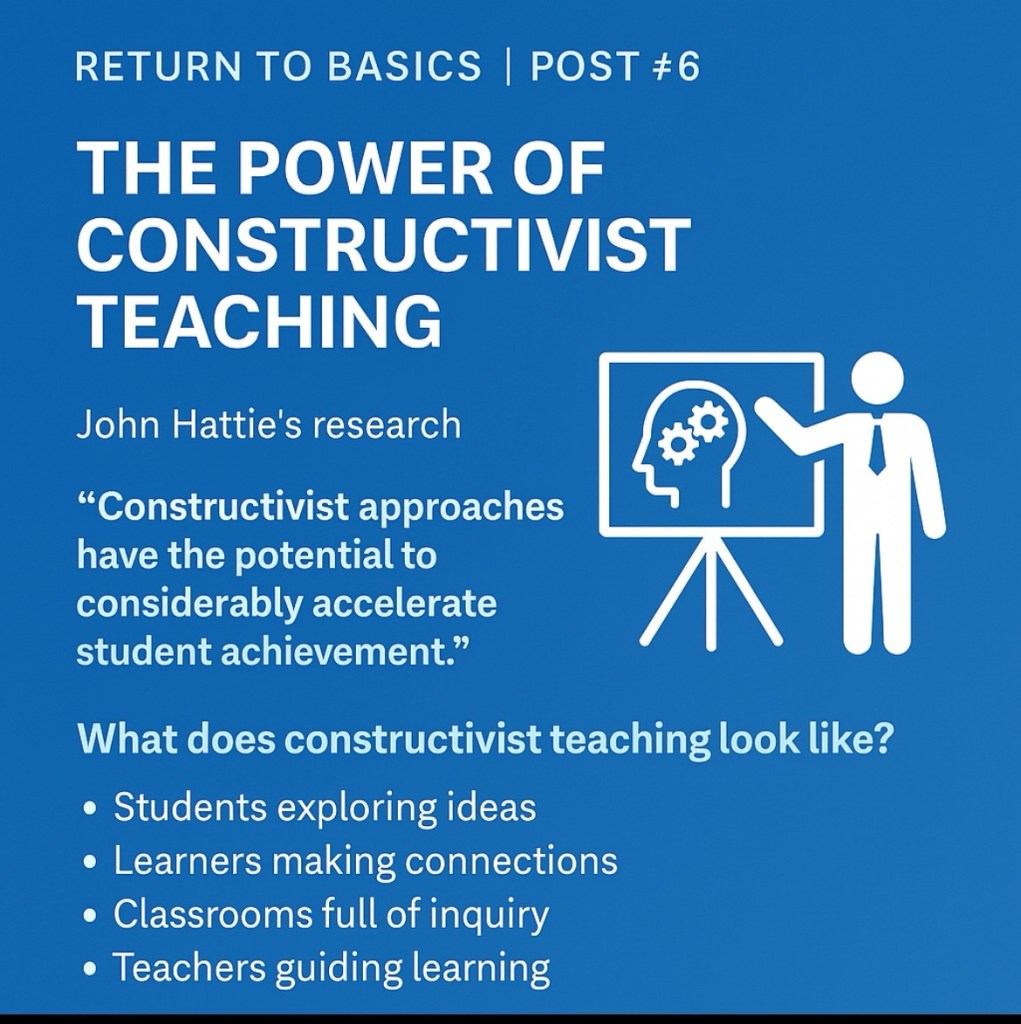
Return to Basics | Post #6: The Power of Constructivist Teaching

In a classroom where learning sticks, students aren’t just receiving information—they’re building knowledge.
That’s the heart of Constructivist Teaching: learning by doing, thinking, questioning, solving.

According to John Hattie’s Visible Learning research, Constructivist Teaching has a weighted mean effect size of 0.90, making it one of the most effective instructional approaches.
This insight is backed by:
• 8 meta-analyses
• 531 studies
• 16,980 students
• 659 measured effects

So what is Constructivist Teaching?
It’s an instructional strategy that places the learner at the center of the process. It encourages students to:
• Explore ideas and possibilities
• Build their own understanding
• Construct explanations and solutions
• Take meaningful action

Why it works:
• It empowers learners to think independently
• It deepens understanding through inquiry and application
• It activates prior knowledge and links it to new learning
• It supports engagement, retention, and transfer

Let’s return to the basics—not the easy ones, but the powerful ones.
Constructivist teaching is not about the teacher stepping back.
It’s about creating the conditions where students step forward.

How do you integrate constructivist approaches in your classroom?

ReturnToBasics #ConstructivistTeaching #HighImpactInstruction #JohnHattie #VisibleLearning #LearnerCentered #AbderrazakBehhar #TeachingStrategies

Return to Basics | Post #5 The Power of Collective Teacher Efficacy


What’s the most powerful force in a school?
Not a curriculum.
Not a technology.
Not a policy.

It’s teachers believing in each other’s capacity to make a difference.

Collective Teacher Efficacy—the shared belief among educators that together they can positively impact student achievement—is one of the highest-impact influences ever studied.

According to John Hattie’s Visible Learning research, this practice has a weighted mean effect size of 1.01, based on:
• 4 meta-analyses
• 132 studies
• 29,135 students
• 132 effects

What does this mean?
When teachers collaborate with a sense of shared purpose and confidence:
• Students benefit from stronger instruction
• School culture becomes solution-focused
• Professional growth becomes collective
• Everyone rises together

Collective teacher efficacy turns isolated practice into empowered action.

When we believe in us, we change what’s possible for them.

Do you work in a school where collective efficacy is visible? How is it nurtured?

No alternative text description for this image

Return to Basics | Post #4 The Power of Teacher Estimates of Achievement


When it comes to accelerating student growth, one of the most powerful tools isn’t a program, a policy, or a platform.
It’s the teacher’s ability to accurately estimate student achievement.

According to John Hattie’s research, Teacher Estimates of Achievement have a weighted mean effect size of 1.29 — among the highest recorded.
This is based on:
• 4 meta-analyses
• 151 studies
• 38,878 students
• 224 effects

What does it mean?
When teachers make informed, thoughtful judgments about where students are, it leads to:
• Setting high, realistic expectations
• Benchmarking past understanding
• Identifying early difficulties
• Choosing effective instructional pathways
• Planning timely interventions

These estimates come from daily teaching practice:
• Observing classroom participation
• Questioning strategies
• Reviewing written and oral work
• Monitoring responses to challenge
• Evaluating assessments and assignments

In short:
Great teachers don’t just teach.
They see. They sense. They steer.

Accurate teacher judgments aren’t just helpful—they are transformational.

How do you refine your estimates of student achievement in your classroom?

No alternative text description for this image

Return to Basics | Post #3 The Power of Direct Instruction


In our search for innovation, we sometimes overlook the structured strategies that consistently yield results. One such practice is Direct Instruction—not to be confused with passive lecturing.

According to John Hattie’s research, Direct Instruction has a weighted mean effect size of 0.56, with the potential to considerably accelerate student achievement. This finding is based on:
• 8 meta-analyses
• 3,052 studies
• Over 520,000 students
• More than 10,000 measured effects

That’s not anecdotal. That’s compelling evidence.

But what is Direct Instruction, really?
It’s a teacher-led approach that is:
• Structured and sequenced
• Driven by clear learning intentions and success criteria
• Committed to student engagement and clarity
• Built around modeling, guided practice, and real-time checking for understanding

In essence: It’s not about the teacher doing all the talking—it’s about doing the right talking, at the right time, with the right support.

Benefits include:
• Clarity: Learning goals are transparent and accessible
• Efficiency: Time is focused on what truly matters
• Equity: Every student has a fair chance to succeed under direct supervision

Let’s not discard what works. Let’s return to what moves learning forward.

Have you revisited Direct Instruction lately? How do you balance it with other approaches in your classroom?

timeline

Return to Basics | Post #2The Power of Clear Learning Objectives


In a world full of complex frameworks and overstuffed curricula, one of the most impactful strategies remains incredibly simple:
“Be clear about what students are expected to learn.”

Research backs this up.
John Hattie ranks Teacher Clarity with an effect size of 0.84—nearly double the threshold for high-impact strategies.
That’s not just good. That’s transformative.

When learning objectives are clear:
• Focus Learning: Students are not guessing what matters.
• Guide Instruction: Teachers plan with purpose.
• Support Reflection: Learners track their growth.
• Make Learning Visible: Parents and leaders recognize progress.

Let’s ditch the jargon. Let’s keep objectives:
• Student-Friendly
• Action-Oriented
• Concept-Driven

Return to basics. Start each lesson with:
“By the end of this lesson, you will be able to…”

It’s not about simplifying teaching—it’s about amplifying learning.

How do you make your objectives meaningful for your learners?

No alternative text description for this image

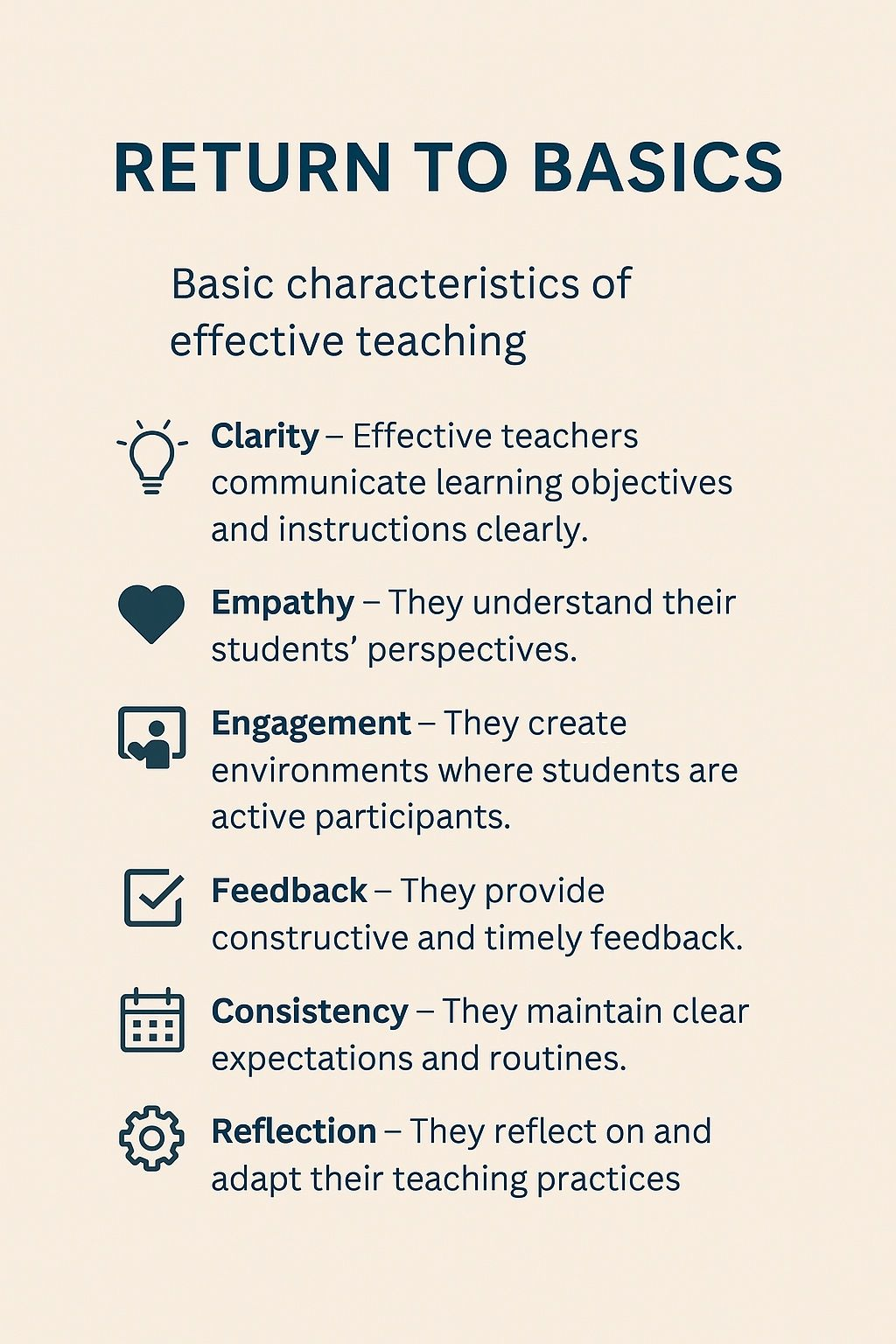
Return To Basics – Post 1: The Essentials of Effective Teaching


In an era of rapid educational trends and high-tech tools, it’s easy to lose sight of what truly matters in the classroom.

Effective teaching is not about flashy presentations or rigid curricula—it’s about connection, clarity, and consistency.

Here are a few basic, yet timeless characteristics of effective teaching:
1. Clarity – Effective teachers communicate learning objectives and instructions in simple, direct ways. Students know what they’re learning and why.
2. Empathy – They understand their students’ perspectives, adapting instruction to meet diverse needs and abilities.
3. Engagement – They create environments where students are curious, active, and emotionally invested in the learning process.
4. Feedback – They provide timely, constructive feedback that encourages growth, not fear.
5. Consistency – They maintain clear expectations and routines that foster trust and stability.
6. Reflection – Effective teachers reflect on their own practice. They ask, “What worked? What didn’t? What can I do better next time?”

As we Return to Basics, let’s remind ourselves that the most powerful teaching often starts with the simplest actions.

What other qualities do you think make teaching effective?