Edusemiotics and the Crisis in Western Educational Philosophy

Western education faces a multifaceted crisis marked by fragmented knowledge, value-neutral practices, and lingering Cartesian dualisms. Edusemiotics – an emerging philosophy of education grounded in semiotic theory – offers a unifying alternative. Drawing on Charles Peirce’s semiotics, John Dewey’s pragmatism, and process ontology, edusemiotics reconceptualizes learning as an interpretive, sign-mediated process. It explicitly challenges representational thinking and mind–body dualism while reintroducing meaning and ethics into education pdfcoffee.com. What follows is an exploration of how edusemiotics addresses six key dimensions of this educational crisis: its philosophical foundations, approach to moral education, epistemology of knowledge, curriculum design, institutional practices, and concrete pedagogical implementations.

Philosophical Foundations: Process Semiosis vs. Representational Dualism

Edusemiotics rests on a semiotic-process ontology that departs from conventional representationalism and dualism. In classical Western thought, knowledge is often seen as an internal re-presentation of an external reality (a “mirror of nature”), and mind is split from body (Cartesian dualism). Edusemiotics breaks with these assumptions. Instead of treating thought as a passive mirror, it views cognition as active semiosis – an ongoing process of interpretation where meaning is made through signs. As Semetsky explains, reasoning in this paradigm “involves active interpretation… versus direct representation; it… connects what are otherwise doomed to remain isolated substances of body versus mind [and] a separation of knowledge and action”philpapers.org. In other words, knowing is not copying reality into the mind, but engaging with the world through signs.

By adopting Peirce’s triadic model of the sign (sign–object–interpretant) and a process-oriented metaphysic, edusemiotics collapses rigid dualisms. Mind and matter, subject and object, self and world are no longer absolute separations but interrelated elements within the continuum of semiosis. Andrew Stables argues that despite explicit rejections of dualism, education has remained haunted by its legacy. He calls for a “post-Cartesian settlement” in which the distinction between mindless “signals” and meaningful “signs” is collapsed, so that “all living (and learning) [is] semiotic engagement”eric.ed.gov. Edusemiotics answers this call by treating everything as sign processes – human experience, the physical environment, and even the self are interpreted as part of an ongoing web of meaning edusemiotics.org. This anti-dualist philosophy prioritizes dynamic processes over static substances: reality is not a collection of inert objects to be represented, but a network of evolving signs in which learners participate. In sum, edusemiotics provides a new philosophical foundation for education that overcomes representationalist “mind-as-mirror” models and the Cartesian splits, replacing them with a holistic, processual view of learning-as-meaning-making philpapers.orgeric.ed.gov.

Moral and Ethical Education: Reclaiming Meaning and Character Formation

One symptom of the contemporary crisis is the moral relativism and value-neutrality pervading many schools. Traditional Western educational philosophy often brackets out questions of virtue or the good life, aiming to be “objective” or leaving values to personal choice. Edusemiotics offers a corrective by re-centering ethical meaning-making as a core educational process. It contends that education cannot be separated from values because knowledge itself carries an ethical charge when understood semiotically (through the unity of knowing and acting pdfcoffee.com). Rather than avoiding moral formation, edusemiotics engages students in the interpretation of signs with an eye toward character and ethical insight.

Moral education in an edusemiotic framework is not about drilling fixed doctrines or, conversely, shrugging that “anything goes.” It is about cultivating the capacity to interpret and respond to the world’s signs in ethical ways. Semetsky notes that a pedagogy informed by edusemiotics “aims to enrich experience with meanings and values” beyond mere factual transmission edusemiotics.org. This means classrooms deliberately surface moral and existential questions inherent in subject matter, prompting students to consider the ethical implications of knowledge. For example, a science lesson might explore environmental data as signs that carry ethical significance about stewardship, rather than treating them as neutral facts.

Importantly, edusemiotics resists both absolute moral certitude and facile relativism. It emphasizes a “relational ethics” grounded in semiotic processes edusemiotics.org. Because understanding grows through interpreting others’ signs, students learn empathy and moral reasoning by engaging with diverse perspectives. Edusemiotic educators encourage dialogue about values, helping students form habits of character such as openness, critical reflection, and compassion. As a result, the classroom becomes a space for ethical inquiry – a community where teacher and students interpret moral “texts” (stories, historical events, personal experiences) together, rather than a value-neutral zone.

This approach contrasts sharply with value-neutral schooling. Instead of pretending to have no stance, edusemiotics makes the formation of moral meaning explicit. It treats ethical dilemmas and even contradictions as valuable learning material, not as issues to be ignored edusemiotics.orgedusemiotics.org. In fact, the semiotic view holds that genuine signs often contain an “included middle” – they can be interpreted in multiple ways – which teaches students to navigate ambiguity and develop principled judgments. Through iterative interpretation, learners internalize that knowledge carries responsibilities. Semiotically, a belief is a habit of action; thus, coming to “know” something implies being disposed to act on it. Edusemiotics builds on this Peircean insight by fostering habits of ethical thinking and action in tandem. Ultimately, edusemiotics envisions moral education as character formation through semiosis: students and teachers continuously interpret signs of right and wrong, refine their values in community, and in doing so “posit new ethics oriented to… mutual understanding and sharing each other’s values”edusemiotics.org. This stands in stark contrast to moral relativism – instead of leaving students rudderless, edusemiotic education guides them to construct meaning within an ethical context, reclaiming a central aim of education that had been sidelined in the name of neutrality.

Epistemology and Knowledge: Semiosis as Interpretive Growth and Truth-Seeking

Modern education also faces an epistemological crisis: knowledge has become fragmented into isolated disciplines, and postmodern skepticism has eroded confidence in truth claims. Edusemiotics directly addresses this by reconceiving knowledge itself as semiosis – the continuous process of meaning-making – thereby offering a way to reunify knowledge and rehabilitate the idea of truth as an evolving interpretive achievement.

In contemporary curricula, students often encounter a disjointed array of subjects and facts, leading to a “fragmentation of knowledge” and a sense that there is no coherent truth, only bits of information. Edusemiotics counters this by providing a unifying epistemological paradigm edusemiotics.org. All knowledge, whether in science, art, or humanities, is seen as part of the same fabric of signs. Rather than teaching subjects as sealed silos, edusemiotic education emphasizes the connections and underlying semiosis that run through different domains of inquiry. Semetsky and Stables describe edusemiotics as an integrative framework precisely “in defiance of the fragmentation of knowledge… prevalent in education”, uniting learning under the common process of sign-interpretation edusemiotics.org. In practical terms, this means students are encouraged to draw links across disciplines – for instance, understanding a historical event might involve scientific data (climate signs), artistic representations, and ethical interpretations, all as part of one meaningful whole.

Crucially, edusemiotics does not abandon truth; it redefines what it means to know something. In place of absolute, static truth or mere subjective opinion, it posits truth as the outcome of ongoing inquiry and interpretation. Knowledge is never final in a semiosic view – it is always provisional and open-ended, subject to growth as new signs emerge and old signs are interpreted in new contexts edusemiotics.org. This resonates with Peirce’s pragmatic notion that truth is what the community of inquirers would eventually agree upon in the long run. Edusemiotics thus teaches students to see learning as a “process… subject to evolution and development”, where understanding deepens through interpreting evidence and context rather than just accumulating facts edusemiotics.org.

By framing learning as interpretive growth, edusemiotics restores meaning to the concept of truth. Students learn that facts are not brute, meaningless data points; they are signs that require interpretation. For example, a set of statistics in a civics class is not “truth” on its own – it must be interpreted (semiotically) within social and ethical contexts to yield meaning. This counters the nihilistic sense that “anything can be true” or that truth doesn’t matter. Instead, learners engage in a continuous truth-seeking dialogue, testing interpretations against experience and alternative signs. Edusemiotics also encourages epistemological pluralism without chaos: since “everything is a sign” but “nothing is a sign unless interpreted” edusemiotics.orgedusemiotics.org, students appreciate that different perspectives (different interpretants) can enrich understanding, yet through reasoned dialogue and evidence, more adequate interpretations can emerge.

In sum, edusemiotics heals epistemic fragmentation by teaching that knowledge is a web of meaning rather than a heap of data. It confronts the loss of truth by showing students that truth is not a fixed commodity to be delivered, but a goal of inquiry – something we approach through collaborative interpretation of signs. Learning becomes “the growth of signs” in Peirce’s sense edusemiotics.org, and education is the nurturing of this growth. This stands as an antidote to both the factoid-driven curriculum and the postmodern shrug, instilling in learners a sense that understanding is achievable through semiotic inquiry even if it is never absolutely final. In edusemiotics, knowledge regains its unity and purpose: it is semiosis oriented toward meaning and truth, continually evolving but grounded in a community’s shared interpretive efforts.

Curriculum: Integrating Meaning Through Interdisciplinary, Relational Inquiry

A practical manifestation of edusemiotics’ philosophy is a reimagined curriculum that reintegrates meaning across subjects. Traditional Western curricula often compartmentalize learning into separate disciplines (science vs. art, etc.) and emphasize rote factual knowledge, leading to what many describe as a loss of meaningful learning. Edusemiotics proposes to redesign the curriculum as a network of signs and relations, fostering interdisciplinary inquiry and situating knowledge in context so that it is rich with meaning for learners.

Interdisciplinarity and integration are hallmarks of an edusemiotic curriculum. Because it views all knowledge domains as part of the semiosphere, edusemiotics naturally encourages crossing boundaries between fields. This is in line with contemporary “STEAM” initiatives (integrating Arts into STEM) and other holistic approaches, but edusemiotics provides a strong philosophical rationale for it. Scholars note that semiotic educators “embrace epistemological fluency, or the value of all communication systems and ways of knowing as a vital goal for education”researchgate.net. In practice, this means a curriculum might blend literature with history, or science with visual art, to explore how different symbol systems convey meaning. For example, a unit on the environment could include scientific data (as signs of ecological change), artistic expressions of nature, and ethical discussions – thereby combining STEM and the humanities in a unified learning experience. Indeed, the semiotic perspective has “already been heralded in the STEAM debate” which merges arts with sciences researchgate.net, illustrating edusemiotics’ call for subjects to “work across discipline areas” rather than in isolation.

Such a curriculum is organized around meaning rather than just content. Instead of lists of topics to cover, an edusemiotic curriculum might be structured by themes, questions, or real-world problems that inherently require multiple ways of knowing. Relational learning is emphasized: students see connections between what they learn in different classes and connect academic knowledge to their own lives. This resonates with John Dewey’s idea that learning should grow out of experience and be directed toward the “continuity of experience.” For instance, rather than teaching mathematics and art separately with no overlap, a relational curriculum might have students explore geometric patterns in Islamic art, thus finding mathematical concepts as meaningful signs within cultural-artistic contexts.

Moreover, edusemiotics advocates for student-centered inquiry in the curriculum. Learning topics are not merely delivered by the teacher but co-constructed through dialogue and interpretation. A lesson becomes a semiotic exploration – perhaps students investigate a concept like “freedom” by interpreting historical documents, literary metaphors, and political cartoons, integrating insights from history, language arts, and civics. This approach not only builds interdisciplinary knowledge but also makes learning personally meaningful, as students actively create the connections (sign relations) themselves.

The curriculum under edusemiotics also welcomes multiple forms of representation and expression. Since meaning can reside in images, gestures, narratives, and other sign systems (not just in verbal text or numbers), an edusemiotic classroom might include rich media and expressive projects. For example, alongside writing essays, students might create concept maps, draw diagrams or symbols to represent ideas, engage in role-plays or storytelling – all viewed as valid semiotic means of learning. This multi-modal approach helps reintegrate creative and affective dimensions into the curriculum, countering the overly rationalistic bent of traditional models. As one description puts it, edusemiotic pedagogy “examines how signs and symbolic systems affect knowledge and learning, emphasizing the use of visual resources, interactive practices, and technologies to facilitate the construction of meanings” researchgate.net. Thus, a science class might use simulations and visual models (iconic signs) to deepen understanding, or a literature class might incorporate artwork and music of the period to contextualize a novel – all these are ways to engage different regimes of signs in learning edusemiotics.org.

In summary, edusemiotics advocates a curriculum of connection and meaning. It seeks to overcome the disconnected, test-driven curriculum by designing learning experiences that are interdisciplinary (bridging subject silos), thematic and relational (organized around meaningful wholes), and multimodal (using various sign systems). The ultimate aim is a curriculum that reflects the unity of knowledge and life: it “opens up a range of opportunities for human development and transformative education”edusemiotics.org by treating every subject as part of a larger signifying process. This reintegrated curriculum not only conveys information but also inducts students into a living web of meaning, better preparing them to navigate and make sense of the complex world beyond the classroom.

Institutional Practices: Relational Pedagogy, Assessment, and Learning Environments

Edusemiotics extends its reformist vision to the very structure of schooling and the teacher–student dynamic, promoting institutional practices that are relational, dynamic, and dialogical. In contrast to the factory-model of education – with its top-down teacher authority, standardized testing, and rigid classroom structures – an edusemiotic approach reconfigures these elements to align with the idea of learning as a sign-mediated dialogue.

Teacher–student relationships in edusemiotic education are reconceived as a partnership in meaning-making. The teacher is not merely a transmitter of pre-packaged knowledge but a fellow interpreter and facilitator of semiosis. This implies a more dialogical classroom culture: teachers and students engage in open-ended inquiry together, each contributing perspectives as interpreters of subject matter. The hierarchy flattens somewhat into a community of inquiry, reminiscent of pragmatist philosopher John Dewey’s vision and semiotician Charles Peirce’s “community of inquirers.” In practical terms, a teacher might pose problems and genuinely invite students’ interpretations, modeling how an expert thinker navigates signs rather than simply delivering answers. The authority of the teacher shifts from commanding obedience to guiding interpretation – leading students in discussion, asking probing questions, and providing contexts, while also learning from students’ unique insights. This fosters a relationship of mutual respect and intellectual trust. As one edusemiotic principle suggests, education should be about “creating reconciling relations between ourselves and others” edusemiotics.org – in the classroom, this translates to teachers and students seeing each other as partners in a common search for meaning.

The structure of learning spaces also becomes more flexible and interactive. A traditional classroom with rows of desks facing a lectern embodies a one-way flow of information. Edusemiotic learning spaces, by contrast, might be arranged to promote communication (circles, clusters for group work, interactive centers), reflecting the belief that knowledge emerges in dialogue and exchange of signs. The environment itself is considered part of the semiosis – wall displays, learning materials, digital media, and even the architecture act as signs that influence learning. Schools may incorporate more open and collaborative areas, where students from different backgrounds can cross paths and exchange ideas (breaking the isolation of classes and grades). Some edusemiotic-inspired educators draw on the concept of the “semiosphere” – the idea that the classroom is an ecosystem of signs – and thus design spaces rich in symbolism, whether it’s through artwork, nature integration, or multicultural elements, to stimulate interpretive engagement.

A particularly transformative area is assessment and evaluation. Western education’s fixation on standardized testing and quantifiable outcomes is at odds with the process-oriented, qualitative nature of semiosis. Edusemiotics argues for reimagining assessment in line with the view that learning is an ongoing process of growth. Rather than relying solely on multiple-choice tests that treat knowledge as static right-or-wrong answers, edusemiotic practice favors more formative and interpretive assessments: portfolios of student work, reflective journals, project performances, dialogues, and other ways to gauge how students are making meaning. This approach recognizes that understanding develops in stages and often through trial and error. In fact, edusemiotics “reformulates the notion of progress” in education – progress is not a linear march toward preset standards, but the evolution of a student’s interpretive abilities and habits edusemiotics.orgedusemiotics.org. In this spirit, failures or mistakes are not merely penalized; they are seen as integral signs in the learning process, to be interpreted and learned from. As Semetsky notes, a semiotic perspective “changes the perception of standards” and even allows failure to “turn into its own opposite” – that is, a positive learning opportunity – by virtue of the insight gained from it edusemiotics.org. In an edusemiotic classroom, a teacher might encourage students to analyze errors (their own or historical examples) as meaningful signs that point the way to deeper understanding, rather than stigmatizing mistakes. Assessment thus becomes more holistic and dialogical, focused on feedback and growth over time rather than one-time scores.

Additionally, institutional policies and curricula organization are made more dynamic. Edusemiotics supports cross-grade mentoring, interdisciplinary teaching teams, and curricular fluidity to respond to student interests – all reflecting a “process-structure” rather than a fixed assembly line edusemiotics.org. The schedule might allow longer blocks for exploratory projects (since semiosis does not unfold in 45-minute fragments neatly), and extracurricular activities could be woven into academic learning (for instance, museum visits or community projects interpreted back in class). Even teacher training is affected: preparing educators in an edusemiotic paradigm means training them to be reflective interpreters of classroom signs (student behaviors, cultural contexts, etc.) and adept at adjusting their strategies in a dynamic way, rather than simply technicians delivering a script. There is an ethical dimension as well – teachers are encouraged to develop self-knowledge and a relational orientation, understanding that their own beliefs and actions are signs that students interpret. This echoes the edusemiotic emphasis on the “relational self” where self and other (teacher and student) are in continuous, cooperative interaction edusemiotics.org.

In summary, edusemiotics advocates for an educational environment that is collaborative, adaptive, and meaning-rich. The teacher-student relationship becomes a dialogical partnership, classrooms transform into interactive semiospheres, and assessment evolves into a qualitative insight into the learner’s interpretive journey. By making these structural changes, edusemiotics aligns the practice of schooling with its philosophy: if learning is indeed the ongoing negotiation of meaning, then the institutions of education should be organized to support communication, creativity, and the continuous evolution of understanding, rather than enforcing static, dualistic, or purely quantitative measures edusemiotics.orgedusemiotics.org.

Practical Implementation: Edusemiotic Pedagogy in Action (K–12 and Higher Education)

Finally, what does edusemiotics look like in practice? Though it is a relatively new movement, examples from both K–12 and higher education illustrate edusemiotic principles at work – in classrooms, teacher education, and even school design. These examples demonstrate edusemiotics as not only a philosophy but an actionable reform movement in education.

Classroom practices (K–12): An edusemiotic pedagogy often involves students actively interpreting a variety of sign systems and contexts. For instance, in a language arts class, instead of simply analyzing a text for predetermined meanings, students might compare a novel with its film adaptation, interpret symbolism in both, and relate themes to current events – essentially treating literature study as a semiotic inquiry where multiple media (words, images, sounds) convey meaning. A science teacher might implement “diagrammatic teaching,” using iconic signs and visual models to help students grasp abstract concepts researchgate.net. Students could be tasked with creating their own diagrams or metaphors for a scientific principle, thereby engaging in expressive semiosis (not just consuming information). Such practices align with the description of edusemiotics as “centered on meaning and communication” and emphasizing visual and interactive resources to help students construct meanings researchgate.net. In elementary schools, a simple example could be a storytelling exercise where children use pictures (drawn or from magazines) to sequence and narrate a story. They learn language, but also learn that images are signs that carry narrative meaning, and they collaboratively interpret each other’s stories, guided by the teacher. This playful activity embodies edusemiotic pedagogy: it’s interdisciplinary (art and literacy), relational (done in groups, sharing meanings), and interpretive (no single “right answer,” but multiple possible stories from the same images).

Another concrete example comes from geography education: a recent study had high school students participate in “counter-mapping” their city – creating alternative maps that highlight cultural and social dynamics (such as community landmarks, personal experiences in places, etc.). The students weren’t just learning cartography; they were treating the city as a text to be interpreted, using maps as a sign system to express and discover meaning in their urban environment researchgate.netresearchgate.net. This is edusemiotic in that it merges social studies, art, and personal narrative, and turns mapping into a dialogue about cultural signs. Across subjects, a unifying theme of edusemiotic practice is that students construct knowledge rather than receive it, by engaging with diverse signs – be they linguistic, numeric, visual, or kinesthetic – and continually discussing and refining their interpretations.

Teacher training and higher education: Edusemiotics also informs how new teachers are prepared and how higher education can embrace these ideas. In teacher education programs, an edusemiotic approach might involve training teachers to become reflective interpreters of classroom life. For example, during practicums, teacher candidates could use semiotic analysis to reflect on classroom interactions: instead of just noting whether a lesson “went well” by test outcomes, they might analyze the signs of student engagement (body language, questions asked, creative work produced) to gauge deeper learning. They learn to see classroom events (even disruptions or student misconceptions) not as problems to suppress, but as meaningful signs of students’ thinking that can guide teaching. Some programs encourage teacher candidates to maintain interpretive journals, recording observations and then parsing them using theories of semiosis – effectively treating teaching itself as an object of semiosis to improve their practice.

In universities, edusemiotics has given rise to courses and research that blend semiotics and education. For instance, a university seminar on “Edusemiotics and Educational Theory” might bring together students of philosophy, education, and linguistics to analyze how sign systems (like language, media, or even architectural design of schools) influence learning. Students in such a course might examine case studies—say, how introducing a school garden (with its natural signs and cycles) impacted children’s science learning and sense of responsibility. Through an edusemiotic lens, they would discuss how the garden functions as a sign environment that teaches interdependence and growth in ways traditional classrooms might not. This kind of inquiry trains future educators and policymakers to think beyond standard models and consider the broader semio-cultural environment of education. In fact, edusemiotic scholars like Inna Semetsky and Andrew Stables have been involved in developing such interdisciplinary programs and workshops globally, indicating a growing influence in higher education edusemiotics.orgedusemiotics.org.

Institutional design: On a school-wide level, some pioneering schools incorporate edusemiotic principles in their design and culture. For example, a K–12 school inspired by edusemiotics might implement thematic “learning communities” instead of strict age-based grades – students of different ages working together on projects (signifying a break from the usual structure and encouraging peer-learning signs). The timetable could be more flexible, allowing longer periods for dialogue-based learning and cross-curricular projects. The school might also engage with community “signs” by inviting local artists, scientists, or elders to share knowledge, thus treating the community as an extension of the classroom semiosphere. One could liken this to the Reggio Emilia approach (in early childhood education), which also treats the environment as the “third teacher” and values symbolic expression; edusemiotics provides a theoretical backbone to such practices, extending them through all levels of schooling.

In higher education, we see trends like transdisciplinary research labs and project-based courses that align with edusemiotic ideals. For instance, a university might host a “Semiosis Lab” where educators, computer scientists, and designers collaborate to create educational games that leverage signs and symbols to teach (turning learning content into interactive sign systems that students play with and interpret). Winfried Nöth, a renowned semiotician and contributor to edusemiotics, has highlighted the importance of such ecological and interactive dimensions – for example, exploring how digital media (as new sign environments) can be used pedagogically without losing the richness of face-to-face dialogue flusserstudies.netresearchgate.net. Practical implementations influenced by Nöth’s ecosemiotics include outdoor education programs where students learn about biology not just from textbooks but by reading the “signs of nature” (tracks, plant indicators, weather patterns), thereby integrating ecological literacy with cultural meaning.

In conclusion, these examples – from classroom activities to teacher training and innovative schools – show that edusemiotics is moving from theory to practice. It serves as both a philosophical worldview and a reform movement pushing for concrete change in education. Key figures like Inna Semetsky, Andrew Stables, and Winfried Nöth have been instrumental in articulating this vision and inspiring educators to experiment with semiotic approaches. As a result, edusemiotics stands as a promising alternative paradigm amid educational crisis: it offers a way to re-enchant education with meaning, by seeing learners not as empty receptacles but as interpreters, by treating knowledge not as inert information but as living semiosis, and by structuring schools not as factories but as vibrant communities of sign-makers and sign-readers. This holistic approach addresses the philosophical shortcomings of Western education and provides practical pathways to reform, suggesting that the future of education could be one where learning and life are reunited through the power of meaning pdfcoffee.comresearchgate.net.

Sources:

  • Semetsky, I., & Stables, A. (2014). Edusemiotics: Semiotic philosophy as educational foundation. [Routledge]. (overview of edusemiotics, its philosophical stance against dualism and knowledge fragmentation pdfcoffee.com)
  • Semetsky, I. (2016). “Introduction: A Primer on Edusemiotics.” In Edusemiotics – A Handbook. (discusses overcoming Cartesian dualism and learning as growth of signs link.springer.comlink.springer.com)
  • Stables, A. (2006). “Sign(al)s: Living and Learning as Semiotic Engagement.” Journal of Curriculum Studies, 38(4). (argues for post-Cartesian view of learning and collapse of sign/signal distinction eric.ed.gov)
  • Semetsky, I. (2017). “Edusemiotics to Date: An Introduction.” Encyclopedia of Educational Philosophy and Theory. (outlines edusemiotics as an anti-dualist, process-oriented philosophy, emphasizing relational ethics and the unity of knowledge and action edusemiotics.orgedusemiotics.org)
  • Deely, J., & Semetsky, I. (2017). Semiotics, Edusemiotics and the Culture of Education. (explores the cultural and interdisciplinary implications of edusemiotics, e.g. STEAM integration and epistemological fluency researchgate.net)
  • Nöth, W., Stables, A., Olteanu, A., et al. (2018). Semiotic Theory of Learning: New Perspectives in the Philosophy of Education. (collection that extends edusemiotic ideas into ecosemiotics, ontology of learning, etc., reflecting Nöth’s contributions)
  • Various authors in Inna Semetsky (Ed.) (2017). Edusemiotics – A Handbook. (practical and theoretical essays on edusemiotic pedagogy, e.g. use of metaphors, diagrams in teaching researchgate.net, and case studies on meaning-centered education)


Crisis in Western Educational Philosophy: A Critical Analysis

Historical Roots: Post-Enlightenment Rationalism and Secularization

Modern Western education traces its lineage to Enlightenment ideals that elevated reason and scientific inquiry while diminishing religious authority. In the wake of the Enlightenment (18th century), schools and universities increasingly embraced secular, rationalist paradigms, breaking from their earlier church-governed, spiritually anchored missions. This secularization was seen as progress, yet it sowed seeds of an identity crisis in education. John Henry Newman famously warned (echoed by Alasdair MacIntyre) that removing theology – the traditional “queen of the sciences” – from the university would fragment the unity of knowledge inters.org. Indeed, without a shared spiritual or metaphysical framework, the various disciplines drifted into isolated silos. Education lost the integrative vision that a transcendent anchoring once provided. The result, as MacIntyre put it, was that a modern university, lacking an overarching moral or spiritual vision, is often “not at fault because it is not Catholic… it is at fault insofar as it is not a university” in the fullest sensemetanexus.net. In other words, the Enlightenment’s secular, pluralistic vision liberated knowledge from dogma but also left it without an obvious unifying purpose.

One consequence of this post-Enlightenment shift was a “disenchantment” of education – a term Max Weber used for the broader cultural loss of mystery and meaning in modernity. Schools became instruments of reason and nation-building, often at the expense of cultivating inner moral or spiritual life. By the 19th and 20th centuries, public education in the West was explicitly non-sectarian. While this neutrality promoted scientific progress and social inclusion, it also meant the loss of a shared narrative about why we learn. As cultural critic Neil Postman observed, humans are “the god-making species” that seek meaning through narratives; yet modern education has struggled to provide a compelling narrative beyond utilitarian success. Postman starkly noted: “Without a narrative, life has no meaning. Without meaning, learning has no purpose. Without a purpose, schools are houses of detention, not attention.” archive.org. In earlier eras, religion or civic humanism supplied such narratives. In a secular age, however, Western education often flounders to justify itself beyond preparing for careers. The loss of spiritual anchoring and grand narratives in education is thus a root cause of the present crisis – students and educators alike can feel that something essential is missing in the soul of schooling.

Ethical and Moral Tensions: Relativism vs. Character Education

The secular and pluralistic turn in Western education brought with it deep moral and ethical tensions. In the absence of a clear moral authority or agreed-upon truth, many schools adopted a stance of value-neutrality or ethical relativism to accommodate diverse viewpoints. Over time, this has led to a palpable decline in formal character education. Allan Bloom, in The Closing of the American Mind (1987), famously observed that virtually all incoming students “believe (or say they believe) that truth is relative”afterall.net. He noted that by the late 20th century, relativism had become the de facto creed taught in primary and secondary schools under the banner of tolerance and openness. As Bloom put it, “Relativism is necessary to openness; and this is the virtue, the only virtue, which all primary education for more than fifty years has dedicated itself to inculcating.”afterall.net. The intention was to avoid dogmatism and promote tolerance, but the unintended outcome was a generation of students skeptical that any moral truths or universal values exist at all. Being non-judgmental became the highest (and sometimes only) virtue, making it difficult to seriously teach right from wrong or cultivate virtue in the classical sense.

This ethos of relativism has directly contributed to the erosion of character education. Where schools once saw part of their mission as shaping the moral character of pupils – instilling honesty, courage, generosity, or what used to be called “virtue” – many today shy away from that task, fearing imposition of partisan or parochial values. Sociologist James Davison Hunter encapsulates this development in his study The Death of Character, arguing that true moral character has withered because society “refused to accept objective good and evil” humanitas.org. In a culture of moral pluralism, schools often reduce ethics to either procedural rules (“be respectful,” “don’t cheat”) or subjective values left to individual choice. The result, as Hunter suggests, is a hollowing out of character – “moral character ceased to be possible as our culture increasingly refused to accept objective good and evil.” humanitas.org Without some notion of higher goods or moral truths, young people are deprived of a strong ethical compass. They may be well-trained in skills, yet not necessarily educated in conscience or virtue.

The tension between moral relativism and moral objectivism in education also plays out in curriculum conflicts and public debates. Attempts to introduce universal ethical education (for example, programs in civic values or “character counts” initiatives) often run aground on disagreements: Whose values? On the other hand, leaving the moral dimension out entirely creates what C.S. Lewis once called “men without chests” – individuals educated in intellect and appetite but not in heart. Philosopher Alasdair MacIntyre, reflecting on modern society at large, noted we live in a time of “interminable moral arguments” with no resolution, because the shared foundations for ethics were shattered by Enlightenment-era individualism humanitas.org. In educational settings, this translates to uncertainty about whether schools should impart any moral vision at all. K–12 teachers may focus on behavior management rather than ethical formation; university curricula often avoid big questions of meaning in favor of specialist knowledge. The crisis of moral education is thus evident in both contexts. For example, a high school might teach students to reason about ethical dilemmas but stop short of affirming any answers, or a college might offer ethics courses that compare frameworks without ever suggesting that some truths could be enduring. The net effect is that students can graduate intellectually skilled but ethically adrift. This moral vacuum in Western education is a core aspect of the broader crisis, leaving many observers to call for a revival of character education or a re-engagement with questions of virtue and the good life.

Epistemological Crises: Fragmentation of Knowledge and Truth

Hand-in-hand with moral relativism has come an epistemological crisis in Western education – a crisis of truth and knowledge. As academic knowledge expanded rapidly in the 19th and 20th centuries, it also fragmented into ever-narrower disciplines and subdisciplines. MacIntyre describes how since the late 1800s, universities saw an explosion of specialized fields, each with its own experts and jargon, leading to “increasing specialization” and the transformation of professors into “professionalized, narrowly focused researchers” metanexus.netmetanexus.net. This fragmentation means that no one, not even scholars, has a holistic view of knowledge; the unity of truth that medieval or Enlightenment thinkers sought has broken apart. Students experience this as a curriculum of disconnected pieces: biology in one period, literature in the next, math after that – each subject sealed off with little integration. Especially in higher education, the pressure to specialize for careers or research is intense. Undergraduates often must choose majors early, and faculty are rewarded for depth in a niche rather than breadth of understanding. The resulting educational experience can feel disjointed. Knowledge is delivered in compartmentalized units, and students may struggle to find coherence or personal meaning in what they learn.

Compounding this is a postmodern critique of truth that has permeated intellectual culture. Lyotard famously defined the postmodern condition as “incredulity towards metanarratives”, meaning a skepticism toward any overarching truth story or framework iep.utm.edu. Grand narratives – whether of scientific progress, enlightenment, or religious salvation – have lost their credibility in many quarters. In education, this translates to a loss of confidence in the idea of objective truth. What remains is a plurality of perspectives and “language games,” often with no way to arbitrate among them. Lyotard and others describe postmodernity as an “age of fragmentation and pluralism” in which knowledge is no longer seen as unified or universally meaningful iep.utm.edu. Students are subtly taught that all claims to truth are historically or culturally relative, and that one should focus on skills or critical analysis rather than seeking Truth with a capital “T.” While this view can encourage open-mindedness, it can also engender cynicism or intellectual paralysis, as learners juggle isolated facts and conflicting viewpoints without any guiding framework. The critique of representationalism in philosophy – the idea that our mind simply mirrors reality – has likewise filtered into educational theory. Rather than viewing knowledge as something we discover about an objective world, many curricula now emphasize knowledge as constructed, interpretive, or socially negotiated. There is merit in these approaches, but taken to an extreme, they contribute to the sense that education has no firm ground. If everything is a construct, students may wonder, why learn one thing versus another?

The “fragmentation of knowledge” is not merely a philosophical abstraction; its effects are felt in classrooms. Paulo Freire, a leading critical pedagogue, argued that the dominant “banking” concept of education (where teachers deposit information into students) gives learners a piecemeal, alienated understanding of reality. In Freire’s words, the more students adapt passively to this approach, “the more completely they accept the passive role imposed on them, the more they tend simply to adapt to the world as it is and to the fragmented view of reality deposited in them.” en.wikipedia.org. Here, fragmentation is seen as a tool of oppression – by keeping knowledge divided and learners passive, the system prevents them from grasping the whole or questioning the status quo. Whether one takes such a radical view or not, it is clear that modern education often lacks epistemological cohesion. High schoolers cram facts for tests with little sense of how those facts connect to life. College students fulfill distribution requirements across disciplines without seeing how, say, science and literature might inform each other. The loss of faith in truth claims has even led some educational programs to avoid content knowledge in favor of pure skills (the logic being that content is always debatable, whereas skills are neutral). The result is an epistemic hollowing-out: students may learn “how to think” in a generic sense, yet not be sure if there is anything true worth thinking about. This epistemological malaise – an environment of information overload and meaning underload – is a defining facet of the crisis in Western educational philosophy.

Curricular Problems: Overspecialization and the Marginalization of Humanities

These philosophical crises manifest concretely in the curriculum. Western education today grapples with what to teach, caught between an impulse toward ever-greater specialization and a growing concern that we are losing breadth, depth, and humanity in the process. One issue is over-specialization. In higher education especially, the multiplication of majors and courses has led to curricula where students delve deeply into one narrow field but may graduate lacking basic knowledge of other areas. A student of engineering might receive little exposure to literature or ethics; a literature major might avoid any science. The ideal of the well-rounded “Renaissance” learner or even the broadly educated liberal arts graduate is harder to realize in an age of hyper-specialization. MacIntyre criticizes this trend, noting that the curriculum has become “a series of specialised disciplines” with at best a “factitious unity” imposed by administrators inters.org. In his view (following Newman), only a guiding philosophy – historically, theology or a robust liberal arts ethos – can unify the curriculum. Absent that, universities risk becoming mere multiversities, collections of unrelated departments. Even at the K–12 level, there is a push for students to specialize early (through specialized magnet programs, Advanced Placement tracks, etc.), which can mean less time on holistic development.

Perhaps the most discussed curricular crisis is the marginalization of the humanities and liberal arts. As education has tilted toward practical utility, subjects like literature, history, philosophy, and the arts have been cut back or deemphasized, especially in public schooling and many career-focused colleges. Philosopher Martha Nussbaum has been one of the prominent voices warning against this trend. She argues that contemporary education has become “increasingly utilitarian, market-driven, career-oriented, and impoverished in its attention to the arts and humanities.” amazon.com. In her book Not for Profit: Why Democracy Needs the Humanities, Nussbaum contends that a narrow focus on vocational skills and profit undermines the deeper purposes of education – namely, to cultivate critical thinking, imagination, empathy, and democratic citizenship laviedesidees.frlaviedesidees.fr. The humanities, she notes, don’t just “make people humane and creative” as an adornment; rather, they are “required for Socratic examination and self-examination”, the very qualities that keep a democracy alive amazon.comamazon.com. Yet budget cuts and policy choices have slashed arts programs in many K–12 schools, and liberal arts requirements in universities have been diluted. In an era of tight resources and intense job competition, disciplines that don’t obviously boost economic productivity are often viewed as luxuries. This dominance of utilitarianism in curriculum is evident from elementary school to graduate school. As one reviewer notes, today “utilitarian goals have been imposed on the entire educational system, from elementary schools to universities”laviedesidees.fr. Education policy emphasizes STEM fields, computer literacy, and job readiness, responding to global economic competition. Standardized testing regimes prioritize reading and math, sometimes to the exclusion of art, music, and history in early grades. At the university level, funding flows to fields deemed economically beneficial, and students flock to majors like finance or computer science, while literature and philosophy departments shrink.

The consequences of these curricular priorities are being critically examined by educators and philosophers. The shrinking space for humanities and general education means students may miss out on opportunities to reflect on ethical and existential questions – “What kind of life is worth living?” – which are rarely addressed in technical courses. Additionally, over-specialization can leave graduates ill-equipped to synthesize knowledge or adapt to career changes that require interdisciplinary thinking. Allan Bloom lamented that students no longer read the great books that provoke fundamental questions, leading to an impoverishment of the soul even as technical knowledge increases afterall.net. Likewise, other critics worry that by treating education chiefly as a commodity for individual advancement (a credential for a job), we neglect education’s role in forming thoughtful, morally responsible citizens. Nussbaum and others remind us that democracy itself is at stake: without history, literature, and philosophy, students may not learn to question authority, understand different cultures, or imagine the world from another’s perspective laviedesidees.frlaviedesidees.fr. In sum, the curricular crisis in Western education is a tension between depth and breadth, between utility and meaning. A balanced education ideally produces both skilled and wise individuals. The current trajectory, however, often tilts toward narrow skills at the expense of wisdom – a trend many see as dangerously short-sighted for both individuals and society.

Institutional and Structural Challenges: Bureaucratization and Commodification

Beyond ideas and curricula, the institutions of education themselves face structural challenges contributing to the crisis. One such challenge is the intense bureaucratization of education systems. As schooling expanded to serve the masses, especially in the 20th century, it adopted industrial-era management techniques: hierarchical administration, standardization of content, and bureaucratic oversight. Today, large public school districts and universities operate with complex bureaucracies that sometimes seem to prioritize administrative compliance and quantitative metrics over the human-centered mission of teaching and learning. Teachers and professors often feel like small cogs in a big machine, constrained by regulations, assessment regimes, and paperwork that leave less time for mentoring students or innovative pedagogy. The system’s scale and rigidity can alienate students as well – a child in a giant school district or a freshman at a sprawling university can feel like just a number. John Dewey long ago critiqued the “rigid regimentation” of traditional schools that treated students as uniform units to be processed schoolofeducators.com. He observed that such schooling ignored the individual capacities and interests of learners, becoming disconnected from their lived experience. Unfortunately, aspects of that factory-model legacy persist. Dewey’s call for education to be more flexible, experiential, and connected to real life is still only patchily realized. Many schools remain disconnected from students’ lived experience, teaching abstract knowledge with little reference to the contexts and communities students inhabit. This structural disconnection can make learning feel irrelevant, prompting disengagement.

Another structural issue is the commodification of education. In modern Western societies, education has increasingly been treated as a commodity – a product one “consumes” or a service one purchases – rather than as a public good or a formative journey. Social critic Ivan Illich, in Deschooling Society (1971), was one of the first to argue that schooling had become an object of consumption and a mechanism of social control. He observed that in modern systems, “education is socially rewarded and hence becomes a coveted object of consumption to be devoured in ever increasing quantities.” ebooks.inflibnet.ac.in Degrees and certifications are the “products” of this consumption, and students (and their families) invest tremendous money and effort to obtain them, sometimes with more focus on the diploma than the learning itself. The market-driven ethos is evident in how universities market themselves, compete in rankings, and treat students as customers. It is also evident in the rise of for-profit colleges and the ballooning student loan industry, particularly in the United States, turning higher education into a high-stakes economic transaction. Nussbaum notes with alarm the emergence of a “culture of market-driven schooling” that threatens to undermine education’s soul amazon.com. When education is seen chiefly as a means to an economic end, the relationship between teacher and student can shift – teachers become service providers, and students become clients expecting a return on investment (often measured in future earnings). This consumer model can erode the deeper sense of scholarly community or the idea of learning as intrinsically valuable. It also tends to sideline any aspects of education not immediately profitable or measurable.

Illich went so far as to warn that treating “valuable knowledge as a commodity” would lead to a dystopia of oppressive schooling ebooks.inflibnet.ac.in. He envisioned a scenario where “sinister pseudo-schools” and information managers would dominate society if we did not challenge the commodification and bureaucratic control of knowledge ebooks.inflibnet.ac.in. While his language is extreme, contemporary observers do see elements of this prophecy: an explosion of edu-business software, standardized test prep services, and even the use of surveillance and data analytics in classrooms to monitor performance. All these trends point to an education system that is increasingly systematized and monetized. Meanwhile, Paulo Freire and other critical educators point out that institutional education, as structured, often serves to reinforce existing social hierarchies. Freire criticized traditional schooling as an instrument of oppression that conditions students to adapt to an unjust society rather than transform it en.wikipedia.orgen.wikipedia.org. In Freire’s view, the bureaucracy, the one-way authority of teacher over student, and the separation of schooling from daily life all work together to domesticate learners. Real-life disconnection is a part of this: students are taught to learn things by rote in school, which they cannot apply to improve their communities, fostering a passive citizenry. Educators influenced by Freire advocate for more experiential, community-engaged learning – exactly the kind of lived connection that bureaucratic structures have difficulty accommodating.

In sum, Western education faces a structural crisis of scale, bureaucracy, and commercialization. Large-scale systems struggle to nurture genuine teacher-student relationships or to tailor learning to individuals’ experiences. Instead, rule-following and standardization dominate, which can sap creativity and meaning. The commodification of learning turns what should be a transformative personal and communal endeavor into a transactional exchange, complete with marketing and debt. These institutional pressures affect both K–12 and higher education. A public high school teacher, for instance, might be constrained by district mandates and test prep to such a degree that they cannot respond to the curious tangents a student might raise. A university professor might find that research output (tied to funding and prestige) is valued more than quality of teaching. Students at both levels can feel a sense of alienation – school appears as an imposed structure rather than a space of growth. All these factors contribute to the overall crisis in educational philosophy, as the very structures meant to facilitate education sometimes end up undermining its deeper purposes.

Conclusion: Toward Reconnecting Education with Meaning and Purpose

The crises outlined – historical, moral, epistemological, curricular, and structural – are deeply interwoven. Together they portray a Western educational landscape that has, in many respects, lost its center. The historical shift to secular rationalism brought tremendous advances in knowledge, yet it also emptied education of a unifying narrative and spiritual dimension. This vacuum gave rise to moral relativism and the retreat from character education, leaving young people without moral bearings. Concurrently, the fragmentation of knowledge and loss of faith in truth made education feel like it’s about “everything and nothing,” a mere assemblage of skills and facts with no higher truth to pursue. In turn, these philosophical confusions manifest in curricula that emphasize utility over wisdom, and in institutions that run like corporations or factories, often crushing the very curiosity and human connection that make learning worthwhile.

Yet, understanding these crises is the first step toward addressing them. Across the decades, thinkers like those we have cited also offer remedies and visions for renewal. Bloom urged a return to timeless books and the pursuit of truth, to reopen young minds rather than “closing” them with facile relativism afterall.net. Dewey championed an education aligned with experience, democracy, and community – essentially calling for schools to be laboratories of living, not ivory towers schoolofeducators.com. Freire envisioned a pedagogy of liberation, where dialogue replaces one-way transmission and learners become critically aware of their world in order to change it en.wikipedia.org. Illich provocatively suggested “deschooling,” dismantling the mass bureaucracies in favor of decentralized learning webs that reconnect learning to life and remove the profit motive ebooks.inflibnet.ac.inebooks.inflibnet.ac.in. Nussbaum and other humanists call for reviving the humanities and arts in education, to cultivate empathic, reflective citizens rather than just efficient workers amazon.comlaviedesidees.fr. And MacIntyre, channeling Newman, reminds us that education needs an integrating vision – be it philosophical or theological – to resist endless fragmentation inters.org.

What these diverse perspectives share is a concern that education must be reconnected to deeper human aims: the search for meaning, the development of virtue, the integration of knowledge, and the service of a good society. The crisis in Western educational philosophy, while daunting, is not a terminal destiny but a call to action. Both K–12 and higher education institutions are experimenting with reforms: integrating curricula around big questions, reintroducing ethics and civic education, encouraging interdisciplinary studies, and adopting teaching methods that engage students’ experiences and agency. The challenge is to overcome the inertia of established structures and the seduction of purely economic reasoning. It requires philosophical clarity about what we value in education. Is education merely a means to a job, or is it also an end in itself – the cultivation of the person and citizen? The crisis has made it evident that when the latter is neglected, something vital is lost.

In conclusion, the Western education system stands at a crossroads. The accumulated critiques – from Enlightenment skeptics to postmodern theorists, from liberal educators to radical ones – all point to the need for a more holistic, value-conscious approach to education. An educational philosophy adequate to our times would restore a sense of unity and purpose: marrying the Enlightenment’s intellectual rigor with a renewed ethical and even spiritual vision. It would treat students not as empty receptacles or customer-consumers, but as whole persons yearning for meaning and connection. It would balance the pragmatic needs of society with the idealistic goal of fostering well-rounded, morally grounded, truth-seeking individuals. Such a transformation is no small task. But as the critical analysis above has shown, the very soul of education is at stake. The crises of Western education, laid bare by critics and philosophers, press us to remember that education is ultimately for something – for the flourishing of human beings and their communities. Reconnecting education with that fundamental purpose is the way out of the crisis, and the way toward a more coherent and life-giving educational future.

Sources:

  • Allan Bloom, The Closing of the American Mind – critique of relativism in modern education afterall.net.
  • James D. Hunter, The Death of Character – on the loss of objective morality and its effect on character education humanitas.org.
  • Alasdair MacIntyre (citing John Henry Newman), “The Very Idea of a University” – on how removing theology led to fragmented curriculum inters.org.
  • Jean-François Lyotard, The Postmodern Condition – defined postmodernity as “incredulity towards metanarratives,” i.e. loss of overarching truth frameworks iep.utm.edu.
  • Paulo Freire, Pedagogy of the Oppressed – concept of banking education and its oppressive, fragmenting effect en.wikipedia.org.
  • Martha Nussbaum, Not for Profit: Why Democracy Needs the Humanities – warns against utilitarian, market-driven education and argues for the vital role of humanities amazon.comlaviedesidees.fr.
  • Ivan Illich, Deschooling Society – critique of institutional schooling, commodification of education ebooks.inflibnet.ac.inebooks.inflibnet.ac.in.
  • John Dewey, Experience and Education – advocates connecting education to real life; criticizes rigid, traditional schooling schoolofeducators.com.
  • Neil Postman, The End of Education – discusses the need for motivating narratives in schooling archive.org.
  • MacIntyre, The End of Education: The Fragmentation of the American University – on overspecialization in universities metanexus.netmetanexus.net.
  • Solange Chavel, “A Crisis of the Humanities?” (review of Nussbaum) – notes imposition of utilitarian goals from elementary to university laviedesidees.fr.

Enhancing Students’ Critical Thinking with AI: Practical Strategies for Educators


In the evolving landscape of education, AI has the potential to significantly enhance students’ critical thinking skills. Here are some practical ways AI can contribute to developing this essential ability:

– **Personalized Learning Paths:**
– AI can tailor educational experiences to challenge students appropriately.
– *Example:* Adaptive learning platforms adjust the complexity of tasks based on individual performance, encouraging students to think critically and solve problems at their own pace.

– **Interactive Problem-Solving:**
– AI can create engaging scenarios that require students to apply critical thinking.
– *Example:* AI-driven simulations and games present real-world problems that students must analyze and solve, fostering a deeper understanding of the subject matter.

– **Instant Feedback:**
– AI provides immediate insights into student performance, helping them refine their thinking process.
– *Example:* AI-powered assessment tools give real-time feedback on assignments, enabling students to reflect on their mistakes and improve their reasoning skills.

– **Diverse Perspectives:**
– AI can introduce students to a wide range of viewpoints and information sources.
– *Example:* AI-curated content that includes diverse perspectives on a topic, encouraging students to critically evaluate different viewpoints and form well-rounded opinions.

– **Enhanced Research Skills:**
– AI can assist students in gathering and analyzing data efficiently.
– *Example:* AI research tools help students find relevant information quickly, teaching them how to discern credible sources and synthesize information effectively.

– **Critical Thinking Exercises:**
– AI can design and deliver exercises specifically aimed at developing critical thinking.
– *Example:* AI-powered platforms that offer puzzles, logic games, and complex problem sets designed to enhance students’ analytical and reasoning abilities.

By integrating AI into the learning process, educators can provide students with the tools they need to develop strong critical thinking skills, preparing them for the challenges of the future.

What are your thoughts on AI’s role in enhancing critical thinking in education?

Ensuring Ethical Use of AI in Education: Practical Steps for Educational Systems


As AI technology becomes increasingly integrated into education, it is crucial to establish ethical guidelines to ensure its responsible and effective use. Here are some practical steps educational systems can follow to promote ethical AI in education:

– **Develop Clear Ethical Guidelines:**
– Establish comprehensive ethical guidelines for AI use in education.
– *Example:* Create policies that outline acceptable AI practices, data privacy standards, and accountability measures.

– **Conduct Regular Audits:**
– Implement routine audits to ensure AI systems comply with ethical standards.
– *Example:* Periodically review AI tools for bias, data security, and effectiveness, making necessary adjustments to maintain ethical integrity.

– **Educate Stakeholders:**
– Provide training and resources for teachers, students, and parents on the ethical use of AI.
– *Example:* Conduct workshops and create informational materials that explain AI’s role in education, ethical concerns, and best practices.

– **Promote Transparency:**
– Ensure AI systems and their decision-making processes are transparent.
– *Example:* Clearly communicate how AI tools work, how data is used, and the impact on student learning to build trust among all stakeholders.

– **Safeguard Student Data:**
– Implement robust data privacy measures to protect student information.
– *Example:* Use encryption and secure storage solutions for student data, and ensure data is only accessible to authorized personnel.

– **Foster Inclusive AI Development:**
– Involve diverse groups in the development and deployment of AI tools.
– *Example:* Include educators, students, and ethicists in AI development teams to ensure tools meet the needs of all users and are free from biases.

– **Encourage Informed Consent:**
– Ensure that students and parents are informed and consent to AI use in education.
– *Example:* Provide clear explanations of how AI will be used and obtain consent from parents and students before implementation.

– **Support Continuous Improvement:**
– Continuously evaluate and improve AI tools to keep pace with ethical standards.
– *Example:* Establish feedback mechanisms for users to report issues and suggestions, and regularly update AI systems based on this input.

By following these practical steps, educational systems can ensure that AI is used ethically, enhancing learning experiences while safeguarding the rights and privacy of all students.

What are your thoughts on these steps for promoting ethical AI in education?

The Dark Side of AI in Education: Risks to Watch Out For


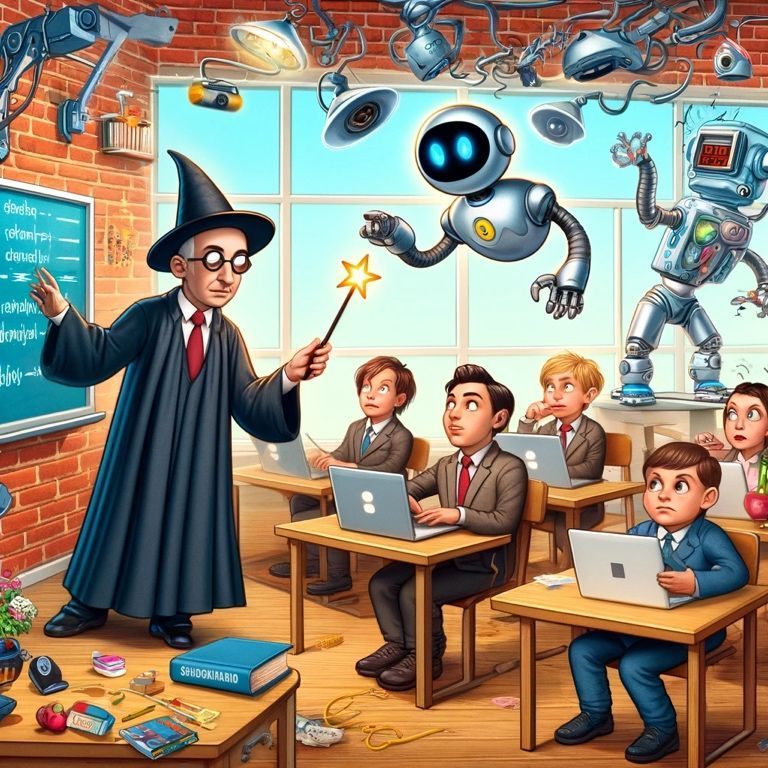
AI technology in education is like a powerful magic wand – it can do amazing things, but if we’re not careful, we might end up turning ourselves into frogs. Here are some key areas where AI could go a bit haywire:

– **Bias and Discrimination:**
– AI systems can unintentionally perpetuate biases present in their training data.
– *Example:* Imagine an AI grading system that’s learned from biased data. You might end up with the Sorting Hat from Harry Potter, but instead of houses, it’s unfairly assigning grades based on race, gender, or socioeconomic status.

– **Privacy Violations:**
– Improper handling of student data by AI tools can lead to privacy breaches.
– *Example:* If student data is mishandled, it’s like leaving your diary open in the school cafeteria – personal secrets could be exposed, leading to all sorts of drama.

– **Lack of Transparency:**
– AI algorithms often operate as “black boxes,” making it difficult to understand how decisions are made.
– *Example:* When an AI decides grades or recommendations, and nobody understands how – it’s like having a magic 8-ball determining your future. “Outlook not so good” is not the feedback we’re looking for!

– **Over-reliance on Technology:**
– Excessive dependence on AI tools can undermine the role of human educators.
– *Example:* Relying too much on AI for teaching might turn classrooms into robot-run factories, where teachers are just glorified tech support. Let’s not turn our schools into the Matrix!

– **Inadequate Oversight:**
– Without proper oversight, AI tools can be misused or malfunction, leading to unintended consequences.
– *Example:* An AI system meant to monitor student behavior could turn into Big Brother, watching your every move and making school feel more like a spy movie than a place of learning.

– **Equity Issues:**
– Unequal access to AI technology can exacerbate existing educational inequalities.
– *Example:* Schools without enough funding might miss out on AI benefits, like being stuck in a black-and-white TV world while others are enjoying the latest 4K Ultra HD.

To keep our AI magic wand from turning into a trickster’s tool, we need solid ethical guidelines, transparency, and lots of input from everyone involved. Let’s use AI to create educational experiences that are as fantastic as a ride on a Hippogriff – thrilling and fair for all!

What are your thoughts on the potential misuse of AI in education?

Authentic Teachers – Enthusiasm

According to Webster’s Dictionary, etymologically, “enthusiasm” means “inspiration or possession by a god.” Authentic Teachers are actually possessed! They are passionate about the act of teaching. This attitude impacts student learning, as enthusiastic teachers are more likely to engage their learners and instill in them a love of what they are learning.

The questions that come to mind are the following:

Is enthusiasm a prerequisite attitude that some teachers have? Or is it a skill to learn?

How does teacher enthusiasm show in practice?

Actually, some teachers are endowed with the bliss of being enthusiastic about teaching for various reasons, ranging from personal traits to a love of an academic subject or/and a love of the teaching profession.

However, teachers can learn how to be enthusiastic if they are well-coached.

Here are key features that typical enthusiastic teachers exhibit:

a. Showing personal passion in what they are teaching, fostering learners’ interest in what they are learning

b. Facilitating new concepts and ideas by exploring connections with the real world. Learners will be engaged if they see genuine value in their learning.

c. Encouraging learners to cultivate personal views on what they are learning. Learners are more likely to be on task if they feel that their opinions matter.

d. Celebrating learners’ successes. This creates an atmosphere of joy and motivation.

e. Leveraging learners’ misconceptions and errors to explore what they learn. This creates a positive mindset and an environment conducive to risk-taking and exploring alternative ways of coming to know.

d. Authentic Teachers use humor to create a relaxed environment and to explain complex concepts. Humor is magical in grabbing learners’ attention and establishing an affective rapport with them.