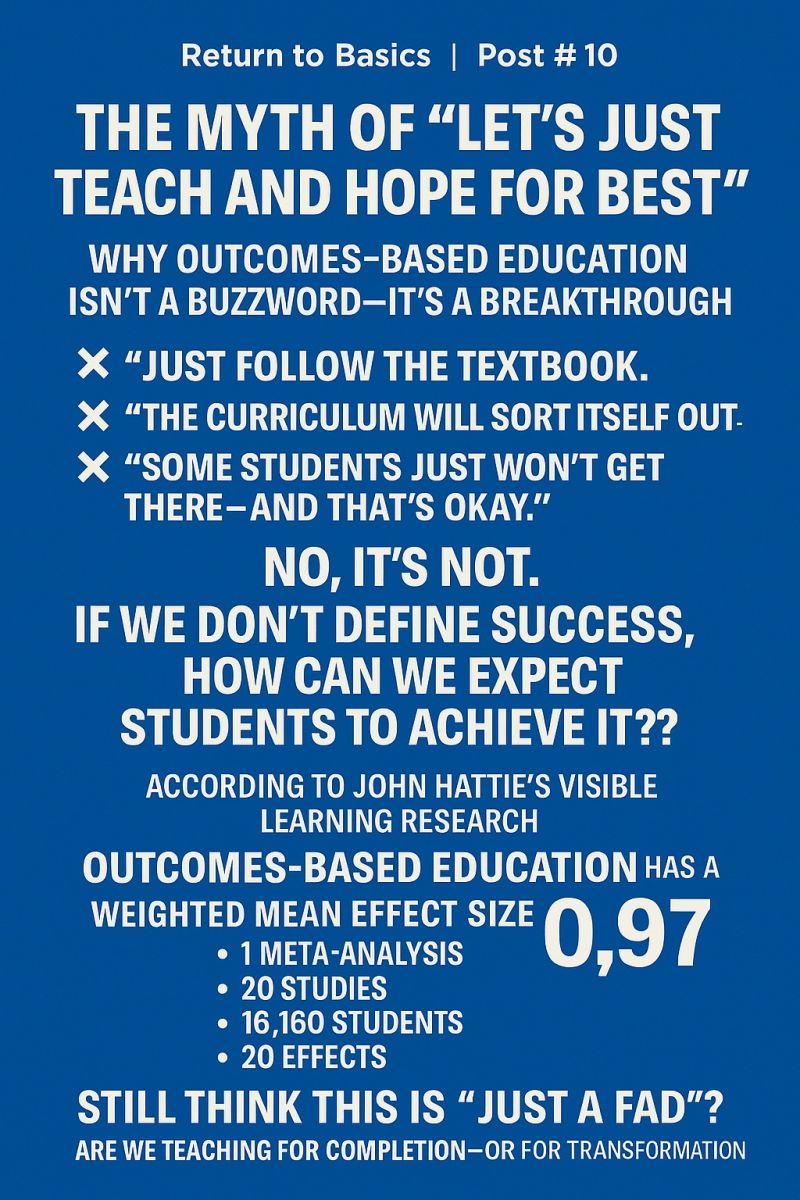
Return to Basics | Post #10: The Myth of “Let’s Just Teach and Hope for the Best”


Why Outcomes-Based Education Isn’t a Buzzword—It’s a Breakthrough

We’ve all heard it:

❌ “Just follow the textbook.”
❌ “The curriculum will sort itself out.”
❌ “Some students just won’t get there—and that’s okay.”

No, it’s not.

Here’s the truth:
If we don’t define success, how can we expect students to achieve it?

That’s the core of Outcomes-Based Education (OBE)—and it’s not what many assume.
It’s not “teaching to the test.”
It’s not “one-size-fits-all.”
It’s not “rigid objectives with no flexibility.”

🔍 OBE means:
• Identifying what truly matters
• Designing learning experiences to reach it
• Expecting all students to achieve it—with the right support

According to John Hattie’s Visible Learning research, Outcomes-Based Education has a weighted mean effect size of 0.97—making it one of the most impactful curriculum approaches ever studied.

📊 Based on:
• 1 meta-analysis
• 20 studies
• 16,160 students
• 20 measured effects

💡 Still think this is “just a fad”?

Outcomes-based thinking forces us to stop glorifying coverage and start prioritizing mastery, equity, and accountability.

Because when the destination is clear, we can build far better pathways.

So here’s the real question:
Are we teaching for completion—or for transformation?

hashtag#ReturnToBasics hashtag#OutcomesBasedEducation hashtag#OBE hashtag#CurriculumMatters hashtag#JohnHattie hashtag#VisibleLearning hashtag#EquityInEducation hashtag#AbderrazakBehhar hashtag#LearningWithPurpose
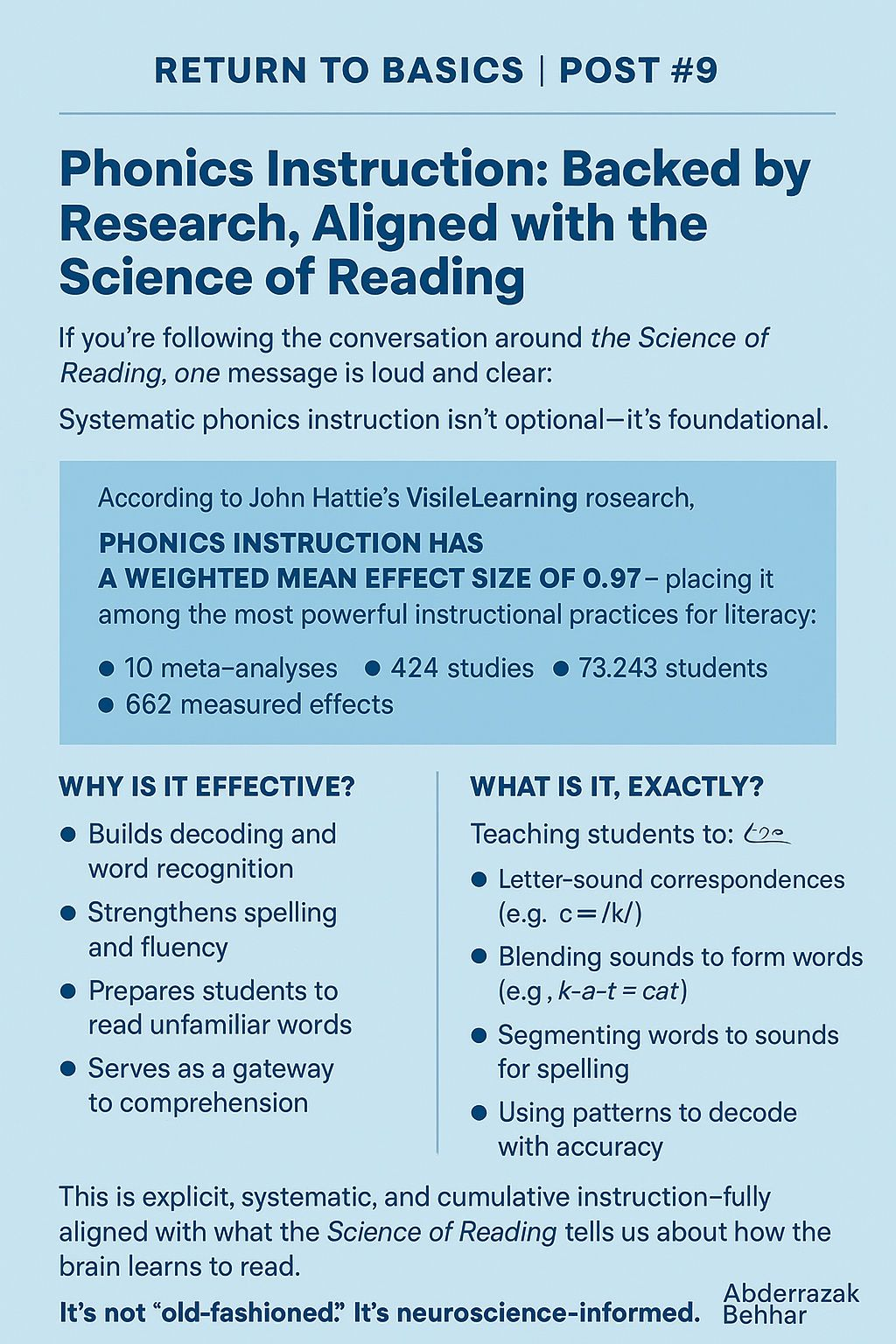
Return to Basics | Post #9: Phonics Instruction: Backed by Research, Aligned with the Science of Reading


If you’re following the conversation around the Science of Reading, one message is loud and clear:
Systematic phonics instruction isn’t optional—it’s foundational.

According to John Hattie’s Visible Learning research, phonics instruction has a weighted mean effect size of 0.97—placing it among the most powerful instructional practices for literacy.
This is backed by
• 10 meta-analyses
• 424 studies
• 73,243 students
• 662 measured effects

✅ Why is it effective?
Phonics instruction:
• Builds decoding and word recognition
• Strengthens spelling and fluency
• Prepares students to read unfamiliar words
• Serves as a gateway to comprehension

✅ What is it, exactly?
Phonics instruction teaches students:
• Letter-sound correspondences (e.g., c = /k/)
• Blending sounds to form words (e.g., k-a-t = cat)
• Segmenting words into sounds for spelling
• Using patterns to decode with accuracy

This is explicit, systematic, and cumulative instruction—fully aligned with what the Science of Reading tells us about how the brain learns to read.

It’s not “old-fashioned.” It’s neuroscience-informed.

As we move forward in literacy reform, let’s stay grounded in what works.

How is your school approaching phonics in light of the new science of reading?

hashtag#ReturnToBasics hashtag#PhonicsInstruction hashtag#ScienceOfReading hashtag#LiteracyMatters hashtag#EarlyLiteracy hashtag#JohnHattie hashtag#VisibleLearning hashtag#ReadingInstruction hashtag#AbderrazakBehhar

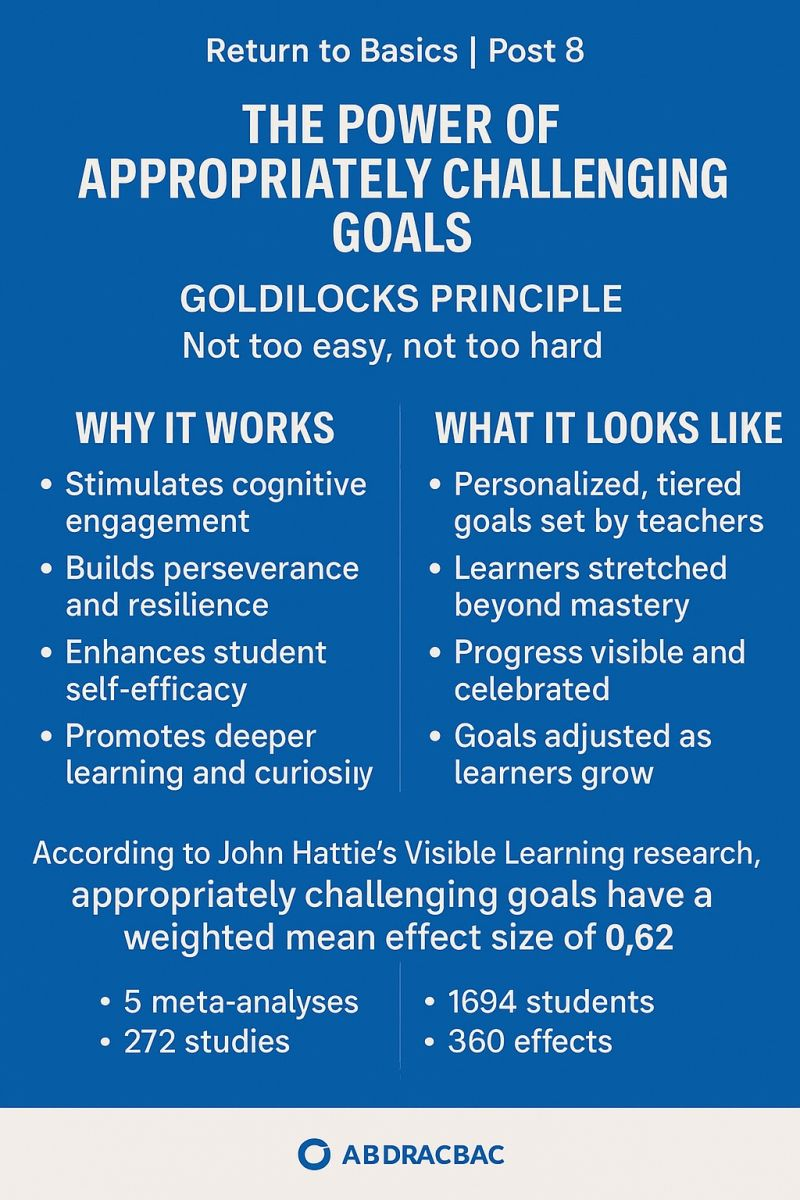
Return to Basics | Post #8: The Goldilocks Principle in Learning: Why Challenge Matters


What drives student growth?
Not just content. Not just effort.
Challenge—just the right kind.

When goals are too easy, students get bored.
When goals are too hard, they disengage.
But when goals are appropriately challenging—not too easy, not too hard—students enter the zone of optimal learning.

This is what John Hattie refers to as the Goldilocks principle of goal-setting.

According to Hattie’s Visible Learning research, appropriately challenging goals yield a weighted mean effect size of 0.62, based on:
• 5 meta-analyses
• 272 studies
• 16,694 students
• 360 measured effects

✅ Why it works:
• Stimulates cognitive engagement
• Builds perseverance and resilience
• Enhances student self-efficacy
• Promotes deeper learning and curiosity

✅ What it looks like in practice:
• Teachers set personalized, tiered goals for students
• Learners are stretched slightly beyond current mastery
• Progress is visible and celebrated
• Goals are adjusted as learners grow

This is not about lowering standards or pushing too hard.
It’s about hitting that just-right challenge level—where students feel the stretch but also see the path forward.

How do you calibrate challenge for your learners?

hashtag#ReturnToBasics hashtag#GoalSetting hashtag#ChallengingGoals hashtag#VisibleLearning hashtag#JohnHattie hashtag#StudentGrowth hashtag#InstructionalLeadership hashtag#AbderrazakBehhar