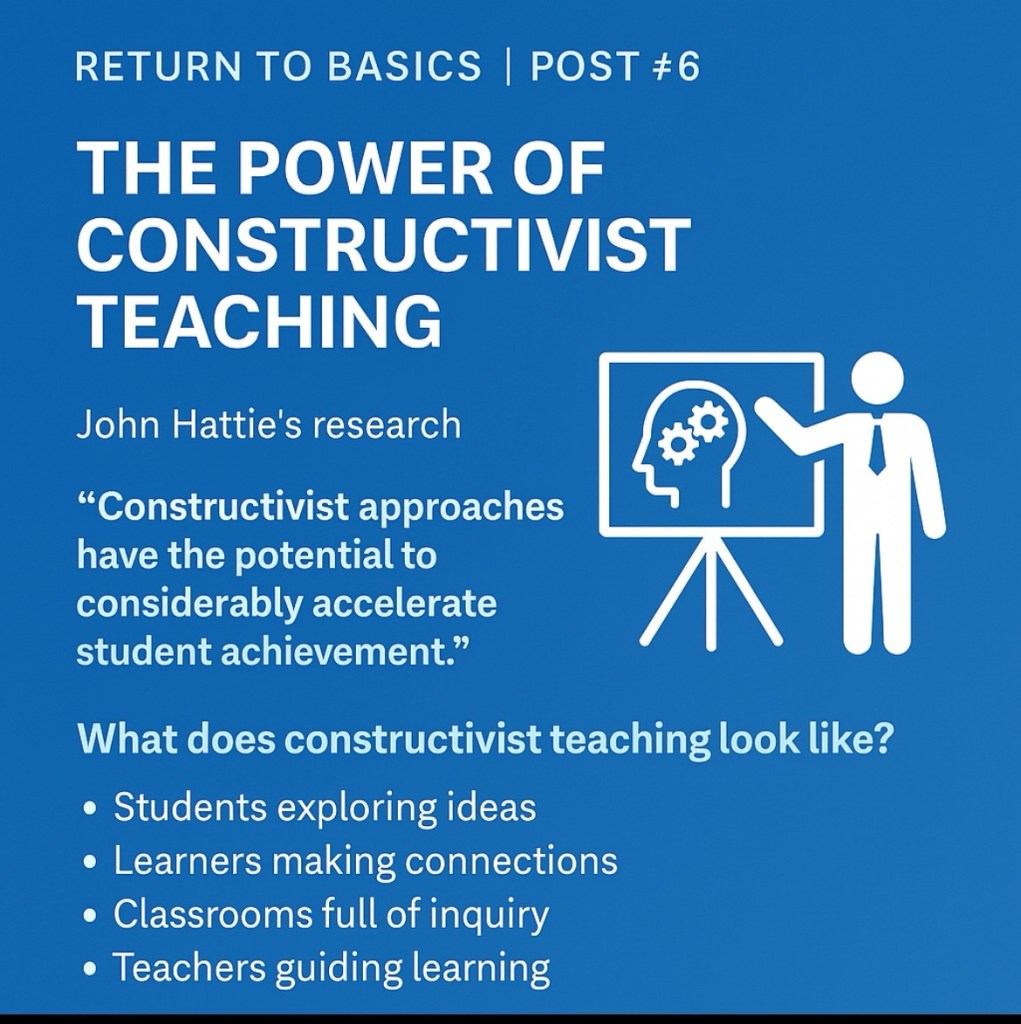
Return to Basics | Post #6: The Power of Constructivist Teaching

In a classroom where learning sticks, students aren’t just receiving information—they’re building knowledge.
That’s the heart of Constructivist Teaching: learning by doing, thinking, questioning, solving.

According to John Hattie’s Visible Learning research, Constructivist Teaching has a weighted mean effect size of 0.90, making it one of the most effective instructional approaches.
This insight is backed by:
• 8 meta-analyses
• 531 studies
• 16,980 students
• 659 measured effects

So what is Constructivist Teaching?
It’s an instructional strategy that places the learner at the center of the process. It encourages students to:
• Explore ideas and possibilities
• Build their own understanding
• Construct explanations and solutions
• Take meaningful action

Why it works:
• It empowers learners to think independently
• It deepens understanding through inquiry and application
• It activates prior knowledge and links it to new learning
• It supports engagement, retention, and transfer

Let’s return to the basics—not the easy ones, but the powerful ones.
Constructivist teaching is not about the teacher stepping back.
It’s about creating the conditions where students step forward.

How do you integrate constructivist approaches in your classroom?

ReturnToBasics #ConstructivistTeaching #HighImpactInstruction #JohnHattie #VisibleLearning #LearnerCentered #AbderrazakBehhar #TeachingStrategies
Authentic Teachers: Centering Learning on Students, Not Compliance

In a world where educational mandates and standards often dominate classroom priorities, authentic teachers stand out. They don’t teach to the curriculum; they teach to the learner. For them, curriculum compliance and coverage are important but secondary. Their true focus lies in meeting learners where they are and guiding them toward meaningful growth.

Authentic teachers consistently demonstrate a powerful, student-centered approach to teaching and learning. Here’s what sets them apart:

1. They Start with the Learner’s Mind

Authentic teachers invest considerable time activating and building upon students’ prior knowledge.
This is not a perfunctory warm-up exercise; rather, it’s a thoughtful process aimed at assessing students’ readiness to engage with new concepts, skills, and information. By anchoring new learning to what students already know and care about, they ensure that conceptual connections are strong and lasting.

2. They Scaffold Learning with Care and Clarity

Rather than leaving learning to chance, authentic teachers are master scaffolders. They set clear learning intentions and success criteria, often supported by real examples of performance tasks. This transparency empowers students to understand expectations, see what success looks like, and feel a sense of ownership over their learning journey.

3. They Empower Student Voice and Choice

Authentic teachers recognize that learning is most powerful when students have agency. They offer meaningful choices in how students demonstrate their understanding, whether through writing, presentations, projects, or other creative forms.
Moreover, they create spaces for students to discuss the relevance of what they are learning and reflect on their progress. Students are not just passive recipients of information—they are active partners in the learning process.